
COLLECTION OVERVIEW (LIST VIEW)


This incomparable collection is aimed at true Game Boy Classic enthusiasts. It represents a comprehensive assembly of original Game Boy DMG-01 hardware from around the world, with a strict focus on items in original packaging.
Beyond hardware, the collection includes a curated selection of games, publications and fan-created material that add cultural and historical depth to the archive.
COLLECTION IMPRESSIONS


COOPERATION & EXHIBITIONS
This archive is at its best in good company. Museums, exhibitions, collectors, makers and researchers are warmly welcome, whether for a joint article, an event or shared documentation. The complete catalogue is shown below.
If you have something in mind, let's talk.

COLLECTION INVENTORY

SE-DMG-NOE
Black was one of the more understated finishes in the European Limited Edition series, a contrast to the brighter reds and yellows in the same colour run.
Nintendo offered the line in red, green, black, yellow, white, blue and clear, and the collection documents every colour. As with all DMG-01 consoles, the hardware is unchanged: a monochrome green screen without a backlight, running on four AA batteries.
SE-DMG-NOE
Black was one of the more understated finishes in the European Limited Edition series, a contrast to the brighter reds and yellows in the same colour run.
Nintendo offered the line in red, green, black, yellow, white, blue and clear, and the collection documents every colour. As with all DMG-01 consoles, the hardware is unchanged: a monochrome green screen without a backlight, running on four AA batteries.

SE-DMG-NOE
The blue Game Boy is one of seven finishes in the European Limited Edition series, which moved the DMG-01 away from its original plain grey into a full range of colours.
Alongside blue, the series ran in red, green, black, yellow, white and clear, and this collection holds the complete set. The console is a standard Game Boy underneath, with the familiar green monochrome screen and four-AA battery setup.
SE-DMG-NOE
The blue Game Boy is one of seven finishes in the European Limited Edition series, which moved the DMG-01 away from its original plain grey into a full range of colours.
Alongside blue, the series ran in red, green, black, yellow, white and clear, and this collection holds the complete set. The console is a standard Game Boy underneath, with the familiar green monochrome screen and four-AA battery setup.

SE-DMG-NOE
This white Game Boy comes from the European Limited Edition colour series. According to the collection's records it was the latest colour to appear and by far the rarest of the run, which makes it one of the harder DMG-01 variants to find today.
The same series was also sold in red, green, black, yellow, blue and clear, and the collection documents the full colour set. The hardware matches every DMG-01: directional pad, A and B buttons, Start and Select, a green monochrome screen without a backlight, powered by four AA batteries.
SE-DMG-NOE
This white Game Boy comes from the European Limited Edition colour series. According to the collection's records it was the latest colour to appear and by far the rarest of the run, which makes it one of the harder DMG-01 variants to find today.
The same series was also sold in red, green, black, yellow, blue and clear, and the collection documents the full colour set. The hardware matches every DMG-01: directional pad, A and B buttons, Start and Select, a green monochrome screen without a backlight, powered by four AA batteries.

SE-DMG-NOE
This is the transparent model from the European Limited Edition colour series. The clear case shows the board and components inside, and see-through Game Boys have always been among the most popular of the coloured variants.
The collection also holds the red, green, black, yellow, white and blue versions from the same European run. Inside, it is a standard DMG-01 with a directional pad, A and B buttons, Start and Select, a green screen without a backlight, and four AA batteries.
SE-DMG-NOE
This is the transparent model from the European Limited Edition colour series. The clear case shows the board and components inside, and see-through Game Boys have always been among the most popular of the coloured variants.
The collection also holds the red, green, black, yellow, white and blue versions from the same European run. Inside, it is a standard DMG-01 with a directional pad, A and B buttons, Start and Select, a green screen without a backlight, and four AA batteries.

HW-USA-3
This is the transparent version of the Game Boy from Nintendo's US Play It Loud series. The clear housing shows the circuit board and components inside, which is part of why the see-through models are among the most sought-after of the coloured DMG-01 variants.
The Play It Loud range also included red, green, black, yellow, white and blue, and the collection holds further examples from the line. Mechanically it is identical to the original Game Boy: directional pad, A and B buttons, Start and Select, a monochrome green screen without a backlight, and four AA batteries.
HW-USA-3
This is the transparent version of the Game Boy from Nintendo's US Play It Loud series. The clear housing shows the circuit board and components inside, which is part of why the see-through models are among the most sought-after of the coloured DMG-01 variants.
The Play It Loud range also included red, green, black, yellow, white and blue, and the collection holds further examples from the line. Mechanically it is identical to the original Game Boy: directional pad, A and B buttons, Start and Select, a monochrome green screen without a backlight, and four AA batteries.

DMG-02
Nintendo's official stereo headphones came with some console sets and were sold separately in Japan as the DMG-02. They plug into the headphone jack on the bottom of the Game Boy and, unlike the console's mono speaker, play sound in proper stereo.
These are the same headphones found in several of the Tetris bundles catalogued in the collection; here they are the standalone Japanese release.
DMG-02
Nintendo's official stereo headphones came with some console sets and were sold separately in Japan as the DMG-02. They plug into the headphone jack on the bottom of the Game Boy and, unlike the console's mono speaker, play sound in proper stereo.
These are the same headphones found in several of the Tetris bundles catalogued in the collection; here they are the standalone Japanese release.

DMG-03
The Rechargeable Battery Pack (DMG-03) was one of the first hardware add-ons for the Game Boy. It holds four rechargeable AA cells that power the console for about ten hours and can also act as an AC adapter.
It came in a standard and a slightly larger version depending on the country's mains voltage. The UK versions, with their straight and later L-shaped plugs, are also catalogued in the collection.
DMG-03
The Rechargeable Battery Pack (DMG-03) was one of the first hardware add-ons for the Game Boy. It holds four rechargeable AA cells that power the console for about ten hours and can also act as an AC adapter.
It came in a standard and a slightly larger version depending on the country's mains voltage. The UK versions, with their straight and later L-shaped plugs, are also catalogued in the collection.

DMG-A-RB-UKV-1
This is the larger UK version of the Rechargeable Battery Pack (DMG-03), holding four rechargeable AA cells for about ten hours of play and usable as an AC adapter.
It has the improved L-shaped plug that Nintendo introduced after the first straight-plug version proved awkward during play. The straight-plug version and the original Japanese DMG-03 are also in the collection.
DMG-A-RB-UKV-1
This is the larger UK version of the Rechargeable Battery Pack (DMG-03), holding four rechargeable AA cells for about ten hours of play and usable as an AC adapter.
It has the improved L-shaped plug that Nintendo introduced after the first straight-plug version proved awkward during play. The straight-plug version and the original Japanese DMG-03 are also in the collection.

DMG-A-RB-UKV
This is the larger UK version of Nintendo's Rechargeable Battery Pack (DMG-03), with four rechargeable AA cells inside for about ten hours of play, also usable as an AC adapter.
This early release has a straight plug, which got in the way during play. Nintendo later switched to an L-shaped plug, and that version is also catalogued in the collection.
DMG-A-RB-UKV
This is the larger UK version of Nintendo's Rechargeable Battery Pack (DMG-03), with four rechargeable AA cells inside for about ten hours of play, also usable as an AC adapter.
This early release has a straight plug, which got in the way during play. Nintendo later switched to an L-shaped plug, and that version is also catalogued in the collection.
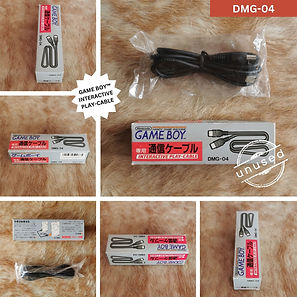
DMG-04
Interactive Play-Cable was Nintendo's original name for the Game Boy link cable (DMG-04), used to connect two consoles for multiplayer gaming.
This model works only with the original Game Boy; to reach later models you use a link cable adapter (MGB-004) or the Universal Link cable with the DMG-14 adapter. The US and UK versions and the shielded DMG-04A are also catalogued in the collection.
DMG-04
Interactive Play-Cable was Nintendo's original name for the Game Boy link cable (DMG-04), used to connect two consoles for multiplayer gaming.
This model works only with the original Game Boy; to reach later models you use a link cable adapter (MGB-004) or the Universal Link cable with the DMG-14 adapter. The US and UK versions and the shielded DMG-04A are also catalogued in the collection.

DMG-98084
The Game Boy supported multiplayer for up to four players, and the Game Link Cable (DMG-04) was the basic piece that connected two consoles directly. For more players you also needed the 4-Player Adapter (DMG-07), which is catalogued separately in the collection.
With most Game Boys sold bundled with Tetris, two-player Tetris was the most popular use for the cable. This DMG-04 works only with the original Game Boy; connecting to later models needs the Universal Link cable (CGB-003) with the DMG-14 adapter. Nintendo later improved the shielding and sold it as the DMG-04A.
DMG-98084
The Game Boy supported multiplayer for up to four players, and the Game Link Cable (DMG-04) was the basic piece that connected two consoles directly. For more players you also needed the 4-Player Adapter (DMG-07), which is catalogued separately in the collection.
With most Game Boys sold bundled with Tetris, two-player Tetris was the most popular use for the cable. This DMG-04 works only with the original Game Boy; connecting to later models needs the Universal Link cable (CGB-003) with the DMG-14 adapter. Nintendo later improved the shielding and sold it as the DMG-04A.

DMG-A-GL 21647
This is the US release of the Game Boy Link Cable (DMG-04), the cable that connected two original Game Boy consoles for head-to-head play, most famously two-player Tetris.
For four-player games it was joined by the 4-Player Adapter (DMG-07). The cable works only with the original Game Boy; linking to later models needs the Universal Link cable (CGB-003) and the DMG-14 adapter. The UK version and the improved DMG-04A are also in the collection.
DMG-A-GL 21647
This is the US release of the Game Boy Link Cable (DMG-04), the cable that connected two original Game Boy consoles for head-to-head play, most famously two-player Tetris.
For four-player games it was joined by the 4-Player Adapter (DMG-07). The cable works only with the original Game Boy; linking to later models needs the Universal Link cable (CGB-003) and the DMG-14 adapter. The UK version and the improved DMG-04A are also in the collection.

DMG-04A
To cut down on electromagnetic interference, Nintendo revised the DMG-04 link cable with better shielding and sold it as the DMG-04A.
It does the same job as the original, connecting two Game Boy consoles, but with cleaner signalling. The earlier DMG-04 cable, in its Japanese, US and UK versions, is also held in the collection.
DMG-04A
To cut down on electromagnetic interference, Nintendo revised the DMG-04 link cable with better shielding and sold it as the DMG-04A.
It does the same job as the original, connecting two Game Boy consoles, but with cleaner signalling. The earlier DMG-04 cable, in its Japanese, US and UK versions, is also held in the collection.

DMG-05
Nintendo's Battery Case (DMG-05) uses four replaceable C batteries to give the Game Boy about 40 hours of extra power, far more than the standard AA setup.
The trade-off is size and weight: it is much larger and heavier than the rechargeable DMG-03. It was released only in Japan and is almost impossible to find today.
DMG-05
Nintendo's Battery Case (DMG-05) uses four replaceable C batteries to give the Game Boy about 40 hours of extra power, far more than the standard AA setup.
The trade-off is size and weight: it is much larger and heavier than the rechargeable DMG-03. It was released only in Japan and is almost impossible to find today.

DMG-06
The Game Boy Soft Case is a storage bag for the console and cartridges, made from Belleseime, a Japanese polyester-and-nylon microfibre that resists dirt and cleans easily. It launched with the original Game Boy in 1989.
It is extremely rare. It was sold only in Japan in a very limited run, and as one of the few Game Boy accessories given its own DMG number (DMG-06), it sits in Nintendo's internal numbering alongside the console itself. For many collectors the Soft Case is the single hardest Game Boy accessory to find.
DMG-06
The Game Boy Soft Case is a storage bag for the console and cartridges, made from Belleseime, a Japanese polyester-and-nylon microfibre that resists dirt and cleans easily. It launched with the original Game Boy in 1989.
It is extremely rare. It was sold only in Japan in a very limited run, and as one of the few Game Boy accessories given its own DMG number (DMG-06), it sits in Nintendo's internal numbering alongside the console itself. For many collectors the Soft Case is the single hardest Game Boy accessory to find.

DMG-07
The 4-Player Adapter (DMG-07) lets up to four players join one multiplayer game. It has a built-in link cable and three further sockets for additional cables, though only a few Game Boy games supported four-player mode.
This is the Japanese version. The adapter was also sold bundled with games such as F1 Race, and those bundles, plus the European boxed release, are catalogued separately in the collection.
DMG-07
The 4-Player Adapter (DMG-07) lets up to four players join one multiplayer game. It has a built-in link cable and three further sockets for additional cables, though only a few Game Boy games supported four-player mode.
This is the Japanese version. The adapter was also sold bundled with games such as F1 Race, and those bundles, plus the European boxed release, are catalogued separately in the collection.

DMG-A-FA- FRG
The 4-Player Adapter (DMG-07) brought multiplayer to the Game Boy, with a built-in link cable and three further sockets so up to four consoles could be joined. Only a few games supported four-player mode.
This is the European boxed version. The Japanese release and bundles pairing the adapter with F1 Race and Top Ranking Tennis are also catalogued in the collection.
DMG-A-FA- FRG
The 4-Player Adapter (DMG-07) brought multiplayer to the Game Boy, with a built-in link cable and three further sockets so up to four consoles could be joined. Only a few games supported four-player mode.
This is the European boxed version. The Japanese release and bundles pairing the adapter with F1 Race and Top Ranking Tennis are also catalogued in the collection.

DMG-TTFA-FAH
The 4-Player Adapter (DMG-07) brought multiplayer to the Game Boy, with a built-in link cable and three further sockets so up to four consoles could be joined, though only a few games supported four-player mode.
This is a very rare bundle that pairs the adapter with Top Ranking Tennis. The same adapter also appears in the collection bundled with F1 Race and in the US Racing Set.
DMG-TTFA-FAH
The 4-Player Adapter (DMG-07) brought multiplayer to the Game Boy, with a built-in link cable and three further sockets so up to four consoles could be joined, though only a few games supported four-player mode.
This is a very rare bundle that pairs the adapter with Top Ranking Tennis. The same adapter also appears in the collection bundled with F1 Race and in the US Racing Set.

DMG P F1 FA
The 4-Player Adapter (DMG-07) brought multiplayer to the Game Boy. It has a built-in link cable and three further sockets, so up to four consoles could be connected, though only a few games supported four-player mode.
This is a sealed US bundle pairing the adapter with F1 Race, which was one of the most-played multiplayer games on the Game Boy. The adapter also appears in the collection bundled with Top Ranking Tennis and in the US Racing Set.
DMG P F1 FA
The 4-Player Adapter (DMG-07) brought multiplayer to the Game Boy. It has a built-in link cable and three further sockets, so up to four consoles could be connected, though only a few games supported four-player mode.
This is a sealed US bundle pairing the adapter with F1 Race, which was one of the most-played multiplayer games on the Game Boy. The adapter also appears in the collection bundled with Top Ranking Tennis and in the US Racing Set.

DMG-08
Dirty cartridge contacts were a common reason for Game Boy games failing to load, and this 1990 Cleaning Kit (DMG-08) was Nintendo's fix. Built in the shape of a cartridge, it slots into the cartridge port, and a plastic stick with pads on both sides wipes the contacts clean.
It is the earlier Japanese release; the collection also holds the US retail version and unlicensed kits.
DMG-08
Dirty cartridge contacts were a common reason for Game Boy games failing to load, and this 1990 Cleaning Kit (DMG-08) was Nintendo's fix. Built in the shape of a cartridge, it slots into the cartridge port, and a plastic stick with pads on both sides wipes the contacts clean.
It is the earlier Japanese release; the collection also holds the US retail version and unlicensed kits.

Custodian-
ship
More than 25 years in the making, and made to continue
One day all good things come to an end...
A collection like this is only ever held in trust for a time. Built and cared for over more than 25 years, it will one day pass to a new custodian who will protect it and carry it forward.
If that is a conversation for you, now or in the future, you are welcome to reach out in confidence.