
From Pocket to Arcade: The Game Boy's Four Arcade Cabinets

Updated: Oct 5
The entire genius of the Game Boy was that it fit in your pocket. Gunpei Yokoi's grey brick took gaming off the living-room table and made it portable, private and personal. So there is something gloriously, wonderfully absurd about a small family of accessories that set out to do the exact opposite: to bolt the humble handheld into a great big, speaker-laden, joystick-wielding arcade machine that you most certainly could not carry anywhere. The collection holds all four of these curious contraptions, and together they make one of the funniest and most endearing corners of the whole Game Boy story.
The Konami HyperBoy: The Licensed Original
The best known of the group is the Konami HyperBoy. Unlike most of these oddities it was an officially licensed product, made by Konami, which gives it a certain respectability the others lack. The Game Boy slots into a cockpit-like housing that adds a proper arcade stick, a large screen magnifier and built-in speakers, transforming the tiny handheld into a miniature stand-up cabinet for the tabletop. It was promoted in Japan with its own advertising, and as the licensed template for the whole idea it is the piece every other unit here was chasing.

The Saitek BoosterBoy: The Biggest of Them All
If the HyperBoy is the respectable one, the Saitek BoosterBoy is the monster. It is probably the largest and most unusual accessory ever made for the Game Boy, a sprawling arcade unit that piles on lighting, powerful stereo speakers, a screen magnifier, an arcade stick and even built-in storage for your games and headphones. It runs on four C batteries, which can also power the docked Game Boy, so the whole ludicrous rig is technically portable, in the sense that a small suitcase is portable. Made by Saitek, it is the accessory that took the arcade idea to its gloriously over-engineered extreme.

The Top Boy: The Unbranded Rival
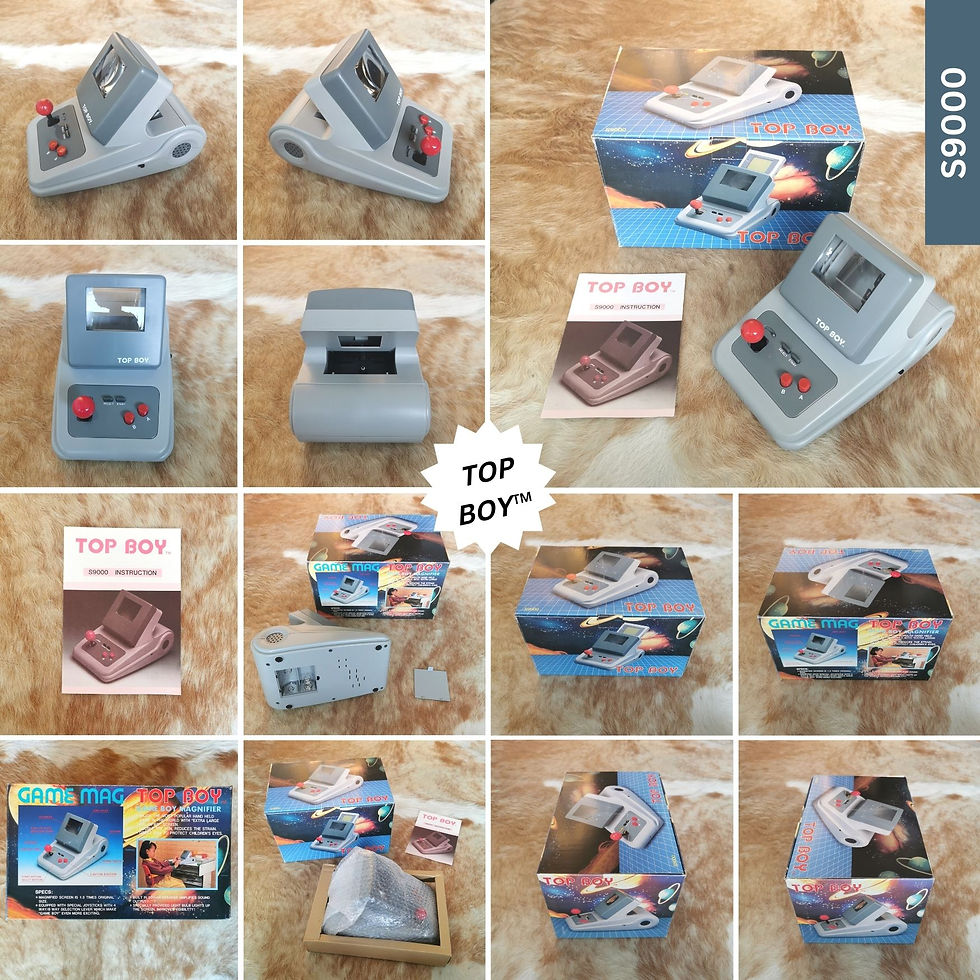
Where there is a hit product, there is an imitator, and the Top Boy is exactly that. A giant of an accessory that swallows the console whole, it copies the HyperBoy formula closely, with powerful stereo speakers, a magnifier, front lights and an arcade stick, all running on two chunky D batteries. The twist is that it is unbranded, an apparently unlicensed, Chinese-made rival with no maker named anywhere on the device. That anonymity is part of its charm: it is a glimpse of the shadow market of clones that trailed every successful Nintendo product, built to ride the same wave without paying for the licence.
The Handy Boy: The Clever Hybrid
The fourth member is the odd one out, and the most practical. The Joyplus Handy Boy is a hybrid: rather than a huge stationary cabinet, it is an all-in-one unit that clips directly onto the Game Boy and travels with it. It answers the handheld's three most common complaints in one go, adding a magnifying lens for the small screen, two little lamps to make up for the missing backlight, and stereo sound through a pair of built-in speakers. Cleverest of all, it needs no batteries of its own, drawing power straight from the Game Boy through a cable. It is the arcade dream shrunk back down to something you could actually put in a bag.

Why Anyone Made These
It is tempting to laugh at the whole idea, and you should, but there is real logic buried in it. The original Game Boy had three genuine weaknesses: a tiny screen, no backlight, and a single small speaker. Every one of these accessories is an attempt to fix all three at once, adding magnification, light and big sound. The arcade stick and cabinet styling were the showmanship on top, turning a practical fix into a fantasy: the chance to feel, just for a moment, like you were playing a real arcade machine rather than squinting at a green rectangle.
They also belong to a wider phenomenon. The Game Boy inspired an enormous third-party ecosystem of clip-on lights, magnifiers, amplifiers and cases, an entire cottage industry built around improving, protecting and accessorising Nintendo's handheld. The arcade cabinets are simply the most extravagant expression of that impulse, the point where a sensible clip-on light grew delusions of grandeur and became a stand-up machine.
There is a period charm to how these were sold, too. The HyperBoy in particular was pushed with its own Japanese advertising, presenting the docked handheld as a genuine home-arcade experience rather than the slightly comical object we see today. That marketing is a reminder that, in the early 1990s, the fantasy was sincere: for a child who could not have a real arcade cabinet at home, a plastic shell with a joystick and loud speakers really could make the Game Boy feel like the machines down at the amusement arcade.
The Arcade Units in the Collection
What makes these pieces so collectible now is exactly what made them impractical then. They are large, fragile and were produced in modest numbers, so complete, boxed examples are genuinely hard to find, and having all four together, the licensed HyperBoy, the giant BoosterBoy, the unbranded Top Boy and the neat little Handy Boy, is a real rarity. Seen side by side they tell a delightful story about a pocket console that some people, against all common sense, simply wanted to make enormous. You can explore all four, and the rest of the DMG-01 world, across the collection.


Comments