
Third-Party Game Boy Hardware, Part 2: Power and Connection

Updated: Oct 2

In part one we met the big names, the brands whose lights, cases and cheat devices defined the accessory aisle. This second part turns to the two most practical problems every Game Boy owner faced: keeping the machine powered, and connecting it to a friend. A whole tier of makers, some famous, some barely documented, built battery packs, chargers and link cables to solve exactly those needs, and the collection holds a deep cross-section. Where a maker's home base is known, it is noted; where it is not, it is left open rather than guessed.
Mad Catz
The American maker Mad Catz, based in San Diego, grew into one of the best-known third-party names in all of gaming. On the Game Boy the collection holds its Power Clip, a rechargeable battery solution, and a Universal Car Adapter for playing on the road. Mad Catz is the archetype of the accessory house that started small on handhelds and went on to become a fixture on every console that followed.
Mad Catz Car Power Adapter MAd Catz Power Clip (CiB)
LMP
LMP focused on the eternal Game Boy problem of power. The collection holds its Power Pack and the more elaborate Powerbase Bundle, the kind of rechargeable kit that promised to free owners from the endless procession of AA batteries. Power solutions like these were among the most genuinely useful accessories anyone could buy for the battery-hungry handheld.
LMP Power Pack LMP Powerbase
Vidis

Vidis is one of the more obscure names in the collection, represented by the Vidis Energy Pack. Little is widely documented about the company, which is exactly what makes pieces like this rewarding to preserve: they are the survivors of the market's long tail, the small makers whose products would otherwise vanish from the record entirely.
iMP

iMP addressed the same need with brute practicality. The collection holds its Heavy Duty Battery Pack, a no-nonsense answer to the console's appetite for power. Straightforward, unglamorous and genuinely useful, it is a good reminder that much of the accessory market was simply about keeping the machine switched on for longer.
Innovation Technologies
Innovation Technologies took power in a more forward-looking direction with its Solar Charger, an early attempt at charging on the go from daylight. The same maker was also behind the Super GB Booster, the adapter that let Game Boy cartridges run on a Sony PlayStation, showing an appetite for ideas well beyond the ordinary.
Solar Charger by Innovation Technologies GB Booster by Innovation Technologies
Joytech
The British maker Joytech specialised in connection. The collection holds its Dual Link Cable and the Multi Link Cable, the cables that turned two Game Boys into a shared game of Tetris or a Pokemon trade. Joytech would go on to become a well-known European accessory brand, but its roots in simple, reliable link cables are on show here.
Joytech Multi Link Cable Game Boy Joytech Link Cable Game Boy (CiB)
IQL

IQL pushed the link cable further with its Dual Link X 4 Player Cable, part of the small family of adapters that tried to expand the Game Boy's two-player nature into genuine multiplayer. Cables like this are a reminder of how much collectors valued the social side of the console, and how many makers competed to enable it.
3Logic

3Logic is another long-tail maker preserved through a single surviving piece, the 3Logic Link Cable. A plain link cable is about as humble as an accessory gets, but each one represents a small company that saw a niche in connecting Game Boys and took its shot at the market.
Yobo
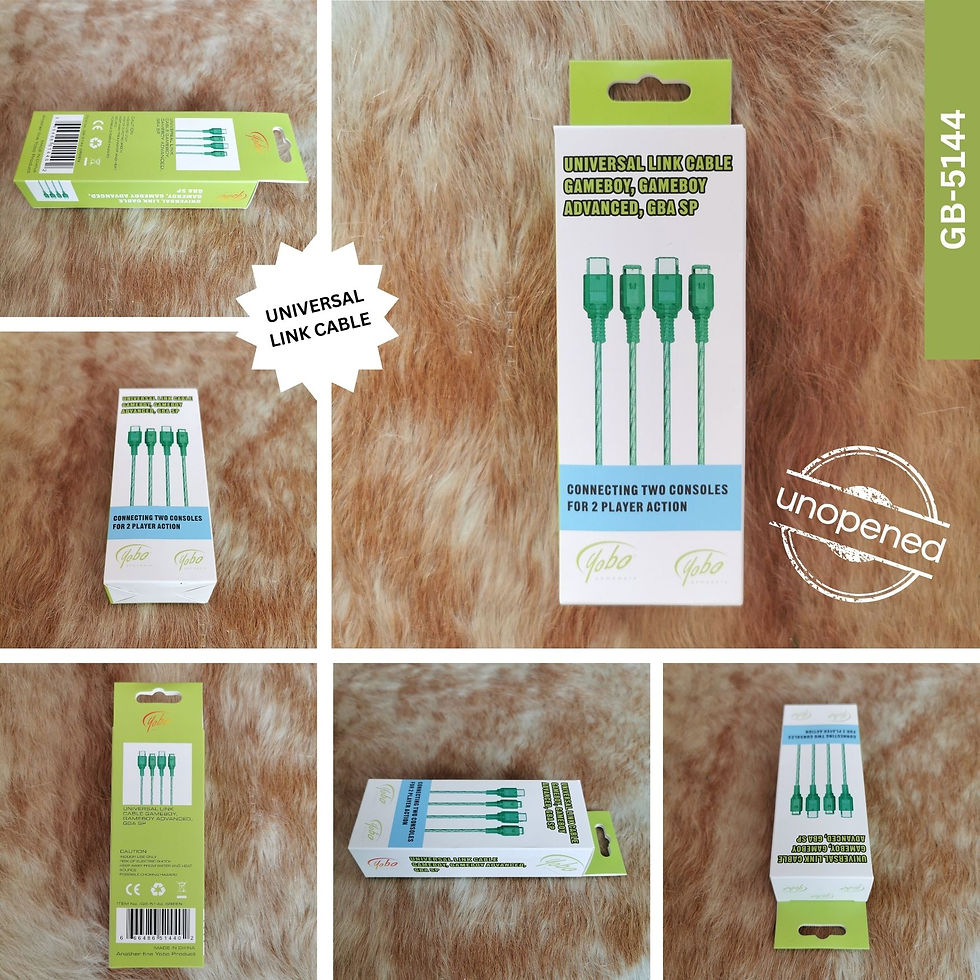
Rounding out the connectivity makers is the American brand Yobo, represented by its Universal Link Cable. Yobo built a reputation for affordable, cross-compatible gear, and a universal cable designed to work across the Game Boy family is a neat encapsulation of that value-first philosophy.
The Series Continues
That is the power-and-connection tier. The third and final part gathers the makers of cases, screens and controllers, and the modern outfits still building for the Game Boy today, including the flash-cart maker keeping homebrew alive.
Every accessory named here is documented, with photos, in the collection.


Comments