
COLLECTION OVERVIEW (LIST VIEW)


This incomparable collection is aimed at true Game Boy Classic enthusiasts. It represents a comprehensive assembly of original Game Boy DMG-01 hardware from around the world, with a strict focus on items in original packaging.
Beyond hardware, the collection includes a curated selection of games, publications and fan-created material that add cultural and historical depth to the archive.
COLLECTION IMPRESSIONS


COOPERATION & EXHIBITIONS
This archive is at its best in good company. Museums, exhibitions, collectors, makers and researchers are warmly welcome, whether for a joint article, an event or shared documentation. The complete catalogue is shown below.
If you have something in mind, let's talk.

COLLECTION INVENTORY

DMG-WJA
After the success of Super Mario Land and Super Mario Land 2, the third game in the series arrived in 1994. This time the player controls not Mario but his greedy rival Wario, who is searching for a home of his own and works through a string of tricky adventures.
Wario Land is the final Super Mario Land game and at the same time the start of the Wario Land series. This is the Japanese release (DMG-WJA); the US version is also catalogued in the collection.
DMG-WJA
After the success of Super Mario Land and Super Mario Land 2, the third game in the series arrived in 1994. This time the player controls not Mario but his greedy rival Wario, who is searching for a home of his own and works through a string of tricky adventures.
Wario Land is the final Super Mario Land game and at the same time the start of the Wario Land series. This is the Japanese release (DMG-WJA); the US version is also catalogued in the collection.

DMG-WJ-USA-1
The third Super Mario Land game arrived in 1994, and this time the player takes the role not of Mario but of his greedy rival Wario, who is looking for a home of his own.
Wario Land is the last game in the Super Mario Land series and the start of the Wario Land series. This is the US release; the Japanese version is also catalogued in the collection.
DMG-WJ-USA-1
The third Super Mario Land game arrived in 1994, and this time the player takes the role not of Mario but of his greedy rival Wario, who is looking for a home of his own.
Wario Land is the last game in the Super Mario Land series and the start of the Wario Land series. This is the US release; the Japanese version is also catalogued in the collection.

DMG-AW2P-NNOE
Wario Land II, released in 1998, is a sequel to Wario Land: Super Mario Land 3 and picks up the story directly. Pirates led by Captain Syrup break into Wario's castle, steal his gold and flood the building, and Wario sets off to get it all back.
This is the European release; the Japanese version is catalogued separately in the collection.
DMG-AW2P-NNOE
Wario Land II, released in 1998, is a sequel to Wario Land: Super Mario Land 3 and picks up the story directly. Pirates led by Captain Syrup break into Wario's castle, steal his gold and flood the building, and Wario sets off to get it all back.
This is the European release; the Japanese version is catalogued separately in the collection.

DMG-P-AW2P(JPN)
Wario Land II, released in 1998, is a sequel to Wario Land: Super Mario Land 3 and continues its story directly. Pirates led by Captain Syrup break into Wario's castle, steal his gold and flood the building.
Wario wakes, repairs the damage, discovers the theft and sets off after the pirates. This is the Japanese release (DMG-P-AW2P); the European version is also catalogued in the collection.
DMG-P-AW2P(JPN)
Wario Land II, released in 1998, is a sequel to Wario Land: Super Mario Land 3 and continues its story directly. Pirates led by Captain Syrup break into Wario's castle, steal his gold and flood the building.
Wario wakes, repairs the damage, discovers the theft and sets off after the pirates. This is the Japanese release (DMG-P-AW2P); the European version is also catalogued in the collection.
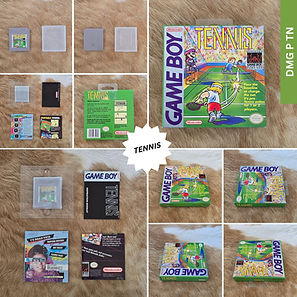
DMG-TN-USA
Tennis is one of the original launch-era Game Boy titles and an early demonstration of Nintendo's handheld vision.
It was among the first games to show off the system's link-cable multiplayer, which became a big part of the Game Boy's social appeal, and it is widely remembered for Mario appearing as the umpire, a small touch of early-Nintendo charm on an otherwise straightforward sports game.
DMG-TN-USA
Tennis is one of the original launch-era Game Boy titles and an early demonstration of Nintendo's handheld vision.
It was among the first games to show off the system's link-cable multiplayer, which became a big part of the Game Boy's social appeal, and it is widely remembered for Mario appearing as the umpire, a small touch of early-Nintendo charm on an otherwise straightforward sports game.

DMG-BS-USA
Baseball was part of Nintendo's first wave of Game Boy software in North America, putting it right at the start of the system's history.
It helped establish the handheld as a platform for quick, competitive link-cable play rather than just puzzle games, and it is one of the purest examples of the early monochrome Nintendo sports line. As a foundational 1989 release it sits among the launch-era titles documented in the collection.
DMG-BS-USA
Baseball was part of Nintendo's first wave of Game Boy software in North America, putting it right at the start of the system's history.
It helped establish the handheld as a platform for quick, competitive link-cable play rather than just puzzle games, and it is one of the purest examples of the early monochrome Nintendo sports line. As a foundational 1989 release it sits among the launch-era titles documented in the collection.

DMG-AW-USA
Alleyway is one of the original Game Boy launch titles and one of Nintendo's earliest attempts to give a simple brick-breaker its own identity.
It is tied to the Mario universe: the player's paddle is styled as Mario's spaceship, and the bonus stages form character shapes from the Mario series. As a foundational 1989 release it captures the stripped-down, experimental spirit of the Game Boy's first generation.
DMG-AW-USA
Alleyway is one of the original Game Boy launch titles and one of Nintendo's earliest attempts to give a simple brick-breaker its own identity.
It is tied to the Mario universe: the player's paddle is styled as Mario's spaceship, and the bonus stages form character shapes from the Mario series. As a foundational 1989 release it captures the stripped-down, experimental spirit of the Game Boy's first generation.

DMG-MJJ
Yakuman is the most hardware-significant of the Japanese launch titles, because it was the first Game Boy game to use the Link Cable, which makes it more important than a niche mahjong game might first appear.
Developed by Intelligent Systems and built around mahjong rather than action or platforming, it is a distinctly Japan-focused launch release that sets itself apart from the internationally familiar launch titles such as Super Mario Land and Alleyway, both of which are also in the collection.
DMG-MJJ
Yakuman is the most hardware-significant of the Japanese launch titles, because it was the first Game Boy game to use the Link Cable, which makes it more important than a niche mahjong game might first appear.
Developed by Intelligent Systems and built around mahjong rather than action or platforming, it is a distinctly Japan-focused launch release that sets itself apart from the internationally familiar launch titles such as Super Mario Land and Alleyway, both of which are also in the collection.

DMG-GO-USA
Golf is one of the original sports foundations of the Game Boy library. Its appeal is historical rather than flashy: it is one of Nintendo's earliest handheld sports titles and a direct descendant of the company's 1984 Famicom golf game.
That gives it a place as a launch-era style title that helped establish the Game Boy as more than a system for action and puzzle games. Golf also appears as a pack-in in one of the console bundles held in the collection.
DMG-GO-USA
Golf is one of the original sports foundations of the Game Boy library. Its appeal is historical rather than flashy: it is one of Nintendo's earliest handheld sports titles and a direct descendant of the company's 1984 Famicom golf game.
That gives it a place as a launch-era style title that helped establish the Game Boy as more than a system for action and puzzle games. Golf also appears as a pack-in in one of the console bundles held in the collection.

DMG-YO-NOE
Mario & Yoshi is a good example of Nintendo branding the same game differently across regions: North America got it simply as Yoshi, while PAL territories received the name Mario & Yoshi.
It is also an early handheld Yoshi puzzle game developed by Game Freak, the studio that would later become world-famous for Pokemon, which gives it an extra layer of interest. The collection also holds several of Game Freak's Pokemon titles.
DMG-YO-NOE
Mario & Yoshi is a good example of Nintendo branding the same game differently across regions: North America got it simply as Yoshi, while PAL territories received the name Mario & Yoshi.
It is also an early handheld Yoshi puzzle game developed by Game Freak, the studio that would later become world-famous for Pokemon, which gives it an extra layer of interest. The collection also holds several of Game Freak's Pokemon titles.
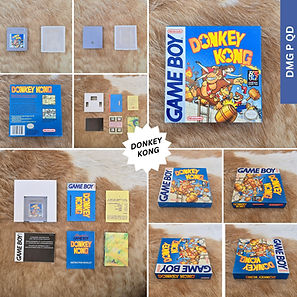
DMG-QD-USA
Donkey Kong on Game Boy looks at first like a straight remake of the 1981 arcade original, then reveals itself as something much larger.
After the familiar opening stages it expands into a full puzzle-platformer with 100 stages, which is why fans often call it Donkey Kong '94. It is also historically important as the first Game Boy game designed for Super Game Boy support, giving it a place as both a game and a technical showcase.
DMG-QD-USA
Donkey Kong on Game Boy looks at first like a straight remake of the 1981 arcade original, then reveals itself as something much larger.
After the familiar opening stages it expands into a full puzzle-platformer with 100 stages, which is why fans often call it Donkey Kong '94. It is also historically important as the first Game Boy game designed for Super Game Boy support, giving it a place as both a game and a technical showcase.
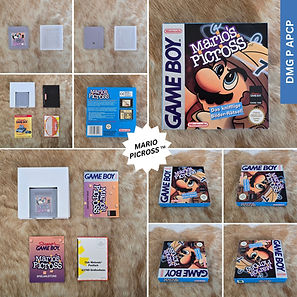
DMG-APCP-NOE
Mario's Picross is one of the Game Boy's most important cult puzzle games and the title that introduced Nintendo's Picross series to Western players.
Despite its quality and later cult status, it sold poorly enough outside Japan that its immediate sequels stayed Japan-exclusive for years. This NOE version is a nice regional piece, Nintendo's original German-market release of a game that would only be fully appreciated internationally much later. The Japanese original, Mario no Picross, is also in the collection.
DMG-APCP-NOE
Mario's Picross is one of the Game Boy's most important cult puzzle games and the title that introduced Nintendo's Picross series to Western players.
Despite its quality and later cult status, it sold poorly enough outside Japan that its immediate sequels stayed Japan-exclusive for years. This NOE version is a nice regional piece, Nintendo's original German-market release of a game that would only be fully appreciated internationally much later. The Japanese original, Mario no Picross, is also in the collection.

DMG-APCJ-JPN
Mario no Picross is the Japanese original of one of the Game Boy's most important cult puzzle games.
Japan was the market where the game actually succeeded; the Western release sold so poorly that Nintendo kept later Picross sequels Japan-only for many years. That makes the Japanese edition historically significant, as the version from the territory where Nintendo's Picross formula first proved itself. The European release, Mario's Picross, is catalogued separately in the collection.
DMG-APCJ-JPN
Mario no Picross is the Japanese original of one of the Game Boy's most important cult puzzle games.
Japan was the market where the game actually succeeded; the Western release sold so poorly that Nintendo kept later Picross sequels Japan-only for many years. That makes the Japanese edition historically significant, as the version from the territory where Nintendo's Picross formula first proved itself. The European release, Mario's Picross, is catalogued separately in the collection.

DMG-AP2J-JPN
Picross 2 is one of the most desirable Japan-exclusive late Game Boy puzzle sequels. It never received an original Western release, which gives it an import-only aura for collectors.
It is a refined follow-up to Mario's Picross, adding both Mario and Wario puzzle sets and Super Game Boy enhancements, making it one of the more historically interesting late Japanese Game Boy puzzlers. The first Mario's Picross, in both its Japanese and European releases, is also in the collection.
DMG-AP2J-JPN
Picross 2 is one of the most desirable Japan-exclusive late Game Boy puzzle sequels. It never received an original Western release, which gives it an import-only aura for collectors.
It is a refined follow-up to Mario's Picross, adding both Mario and Wario puzzle sets and Super Game Boy enhancements, making it one of the more historically interesting late Japanese Game Boy puzzlers. The first Mario's Picross, in both its Japanese and European releases, is also in the collection.

DMG-VU-UKV
Dr. Mario was Nintendo's great attempt to create a second handheld puzzle phenomenon after Tetris.
Its medical, virus-clearing theme gave Nintendo a puzzle identity entirely different from falling blocks, and it became one of the system's most recognisable early competitive puzzle games. The UK edition is interesting to collectors because Dr. Mario went through several British print variants, so regional and print-run differences matter more here than one might expect.
DMG-VU-UKV
Dr. Mario was Nintendo's great attempt to create a second handheld puzzle phenomenon after Tetris.
Its medical, virus-clearing theme gave Nintendo a puzzle identity entirely different from falling blocks, and it became one of the system's most recognisable early competitive puzzle games. The UK edition is interesting to collectors because Dr. Mario went through several British print variants, so regional and print-run differences matter more here than one might expect.

DMG-AGAE-USA
Game & Watch Gallery is a 1997 Game Boy title that brought Nintendo's pre-Game Boy handheld games to the console in collectible form. Each included Game & Watch game can be played in an original-style Classic version and in a Mario-themed Modern remake, so the cartridge has both preservation value and a fresh take on the old games.
It also has an unlockable gallery of the original Game & Watch animations, which gives it the feel of a small museum on a cartridge. This is the US edition; the Japanese follow-up, Game & Watch Gallery 2, is catalogued separately in the collection.
DMG-AGAE-USA
Game & Watch Gallery is a 1997 Game Boy title that brought Nintendo's pre-Game Boy handheld games to the console in collectible form. Each included Game & Watch game can be played in an original-style Classic version and in a Mario-themed Modern remake, so the cartridge has both preservation value and a fresh take on the old games.
It also has an unlockable gallery of the original Game & Watch animations, which gives it the feel of a small museum on a cartridge. This is the US edition; the Japanese follow-up, Game & Watch Gallery 2, is catalogued separately in the collection.

DMG-AGIJ-JPN
Game Boy Gallery 2 is a Japan-exclusive entry that collectors value precisely because its first release stayed tied to the original monochrome hardware.
It continued Nintendo's museum-like revival of classic Game & Watch titles, offering both original-style and modernised versions, so one cartridge works as both a playable tribute and a reinterpretation of Nintendo's pre-Game Boy handheld history. It is also Super Game Boy enhanced, which adds technical appeal as a late-era original Game Boy title. The first Game & Watch Gallery is also catalogued in the collection.
DMG-AGIJ-JPN
Game Boy Gallery 2 is a Japan-exclusive entry that collectors value precisely because its first release stayed tied to the original monochrome hardware.
It continued Nintendo's museum-like revival of classic Game & Watch titles, offering both original-style and modernised versions, so one cartridge works as both a playable tribute and a reinterpretation of Nintendo's pre-Game Boy handheld history. It is also Super Game Boy enhanced, which adds technical appeal as a late-era original Game Boy title. The first Game & Watch Gallery is also catalogued in the collection.

DMG-YT-UKV
Donkey Kong Land is the best-selling Donkey Kong game ever released for a Game Boy system, and one of the most distinctive original Game Boy cartridges because it shipped in a yellow shell rather than the usual grey.
It sold about 3.91 million copies worldwide, which gives it real historical weight. Rare managed to bring the visual identity of Donkey Kong Country onto monochrome hardware using pre-rendered graphics, making it one of the most technically impressive platformers on the original Game Boy.
DMG-YT-UKV
Donkey Kong Land is the best-selling Donkey Kong game ever released for a Game Boy system, and one of the most distinctive original Game Boy cartridges because it shipped in a yellow shell rather than the usual grey.
It sold about 3.91 million copies worldwide, which gives it real historical weight. Rare managed to bring the visual identity of Donkey Kong Country onto monochrome hardware using pre-rendered graphics, making it one of the most technically impressive platformers on the original Game Boy.

Prototype
This is a Loopz developer cartridge, a working Game Boy prototype rather than a retail copy. Instead of a factory mask ROM, it carries a socketed ceramic EPROM on a 256-kilobit development board, its quartz window covered by a strip of masking tape hand-labelled "LOOPZ 10/30", almost certainly a build date or version jotted down by whoever burned this copy.
Loopz is a tile-fitting puzzle game designed by Ian Upton, first seen on the Atari ST in 1989. The 1990 Game Boy version was programmed by Argonaut Software and published by Mindscape for rights-holder Audiogenic. This board came from the collection of the late Steve McKay, a Nintendo of America distributor, and was later verified and dumped by preservationist Frank Cifaldi, giving it a documented chain of custody from an attic find to a public preservation event.
The full story of this prototype is told in the museum journal: The Loopz Developer Cartridge.
Prototype
This is a Loopz developer cartridge, a working Game Boy prototype rather than a retail copy. Instead of a factory mask ROM, it carries a socketed ceramic EPROM on a 256-kilobit development board, its quartz window covered by a strip of masking tape hand-labelled "LOOPZ 10/30", almost certainly a build date or version jotted down by whoever burned this copy.
Loopz is a tile-fitting puzzle game designed by Ian Upton, first seen on the Atari ST in 1989. The 1990 Game Boy version was programmed by Argonaut Software and published by Mindscape for rights-holder Audiogenic. This board came from the collection of the late Steve McKay, a Nintendo of America distributor, and was later verified and dumped by preservationist Frank Cifaldi, giving it a documented chain of custody from an attic find to a public preservation event.
The full story of this prototype is told in the museum journal: The Loopz Developer Cartridge.

DMG-P-HFAJ-JPN
Pocket Family GB is a Japan-only life simulation game released by Hudson for the Game Boy, in which the player looks after a small household, furnishing rooms, earning and spending money and tending to the family that lives there. It runs on the original DMG-01 in monochrome and is Super Game Boy enhanced.
Its stand-out feature is the GB KISS logo on the box. GB KISS is Hudson's infrared system, with the transmitter built into the cartridge itself through the HuC-1 chip, so two players could beam data between copies without a link cable, simply by holding the two Game Boys close together. Because the infrared hardware sits in the cartridge rather than the console, the feature works even on the original DMG-01, years before the Game Boy Color introduced a built-in infrared port.
A sequel, Pocket Family GB2, later followed on the Game Boy Color.
DMG-P-HFAJ-JPN
Pocket Family GB is a Japan-only life simulation game released by Hudson for the Game Boy, in which the player looks after a small household, furnishing rooms, earning and spending money and tending to the family that lives there. It runs on the original DMG-01 in monochrome and is Super Game Boy enhanced.
Its stand-out feature is the GB KISS logo on the box. GB KISS is Hudson's infrared system, with the transmitter built into the cartridge itself through the HuC-1 chip, so two players could beam data between copies without a link cable, simply by holding the two Game Boys close together. Because the infrared hardware sits in the cartridge rather than the console, the feature works even on the original DMG-01, years before the Game Boy Color introduced a built-in infrared port.
A sequel, Pocket Family GB2, later followed on the Game Boy Color.

Custodian-
ship
More than 25 years in the making, and made to continue
One day all good things come to an end...
A collection like this is only ever held in trust for a time. Built and cared for over more than 25 years, it will one day pass to a new custodian who will protect it and carry it forward.
If that is a conversation for you, now or in the future, you are welcome to reach out in confidence.