
The Game Boy Around the World: One Console, Eleven Stories

Updated: 4 days ago

The Game Boy is often told as a single story: a Japanese company makes a clever handheld, bundles it with Tetris, and sells a hundred million of them. But that tidy version hides something far richer. The same grey box lived a startlingly different life on every continent it reached, shaped by trade politics, piracy, climate, marketing and sheer local ingenuity.
This series follows the Game Boy around the globe, one region at a time. Each article is a self-contained story; together they map how a single machine became a truly worldwide phenomenon, sometimes in ways Nintendo never intended. Here is the tour.
Why One Machine Could Travel So Far
Before the tour begins, it is worth asking why the Game Boy, of all consoles, could adapt to so many wildly different worlds. The answer lies in how it was designed. Its creator, Gunpei Yokoi, followed a philosophy he called lateral thinking with withered technology: instead of chasing the newest, most powerful components, he deliberately chose cheap, mature, low-power parts and used them cleverly. You can read the full story of that mindset in our profile of the genius of Gunpei Yokoi.
That single decision is why the same grey box thrived on an Australian beach and in an African village alike: a reflective screen that gets clearer in bright sun, batteries that last for many hours, and a rugged shell that shrugs off dust, heat and drops. The frugal engineering that critics mocked in 1989 is exactly what let the console survive far from any repair shop or reliable mains socket. If you want to see how those parts fit together, our teardown of the anatomy of the DMG-01 takes the machine apart, and the wider birth of the console is told in our history of the DMG-01 itself.
Where It Began
In Japan, the console was born in 1989 with mahjong launch titles, Japan-only games and a merchandising machine that pounced on day one. In North America, one decision, bundling Tetris, turned a gadget into a mass-market obsession. And in Europe, the console fractured into a dozen markets, each with its own bundles, coloured consoles and campaigns.
The Surprising Chapters
Some regions rewrite the story entirely. Russia gave the console its soul, because Tetris was born in a 1984 Soviet computer lab. Across much of Asia, players met the Game Boy through a vast grey market of clone handhelds and hundreds-in-one multicarts. And in Korea, the console wore a disguise, sold by Hyundai as the Mini Comboy to sidestep restrictions on Japanese products.
To the Edges of the Map
In Australia, the console's most-mocked flaw, its unlit screen, turned out to be perfect for the sun. In Brazil, tariffs and piracy pushed Nintendo to let Playtronic build the Game Boy locally, the first time its hardware was ever manufactured outside Japan. In India, the console never officially launched, yet arrived in suitcases and now fuels a growing retro scene. In Africa, long battery life, a sunlight-readable screen and near-indestructible hardware made the Game Boy quietly ideal far from any official distributor.
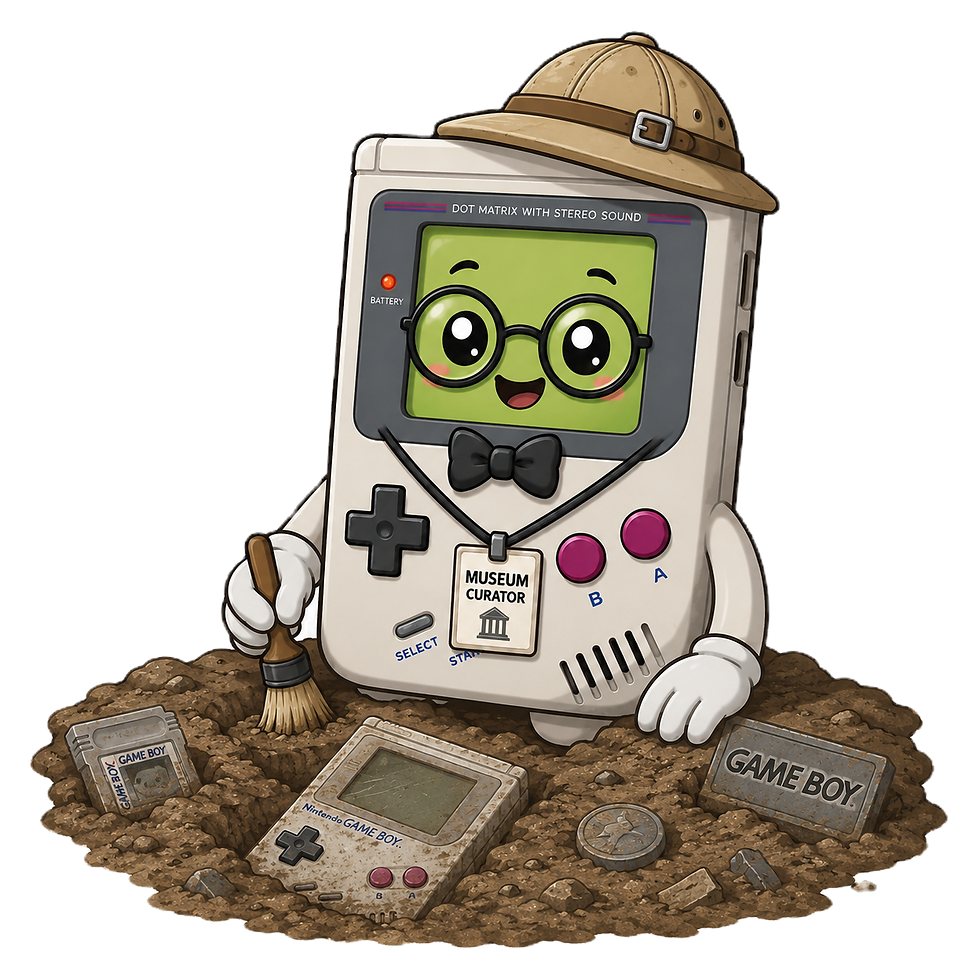
And in Switzerland, the small Alpine country that is home to this very museum, the console arrived quietly through a local distributor and, decades later, found someone determined to preserve its whole worldwide story.
Treasures From Every Region
Each of these stories left physical traces, and many of them live in the museum's catalogue. Japan alone produced some of the strangest artefacts: the mahjong launch title Yakuman that never left the country, the barcode-scanning Namcot Barcode Boy, and the fishing-sonar cartridge, the Bandai Pocket Sonar, both Japan-only oddities that show how far the platform stretched at home.
Europe's fragmentation shows up just as clearly in the catalogue: the German Classic Tetris bundle (NOE) is one of many nationally specific boxes Nintendo of Europe produced, each with its own language and code. And the grey market that defined the console across Asia is captured perfectly by an object like the GB Smart Card, a single chip crammed with dozens of games. Follow any link below to dive into a region, and its artefacts, in full.

One Machine, a Whole World
Taken together, these eleven stories show that the Game Boy was never really one thing. It was a Japanese toy, an American icon, a European patchwork, a Soviet puzzle, an Asian bootleg, a Korean secret, an Australian sun-companion, a Brazilian home build, an Indian rarity, an African survivor and a Swiss homecoming, all at once. Explore the full archive behind these stories at the Game Boy Museum.


Comments