
The Game Boy Link Cable: The Little Wire That Made Gaming Social

Updated: Oct 2
It is easy to overlook the most important Game Boy accessory of all, because it is just a cable. Yet that little grey wire did something no amount of processing power could: it turned a solitary toy into a shared experience. Plug two Game Boys together and the playground changed, the family car changed, and eventually the entire culture around the console changed. The link cable is where Nintendo quietly invented pocket multiplayer.
What the Game Boy Link Cable Actually Did
Every Game Boy has a small serial port on its side, and the link cable simply joins the ports of two consoles so they can send data back and forth. It sounds mundane, but this was head-to-head play years before wireless was practical or affordable. Two players, each with their own screen and their own copy of a game, could share a single match. That simple capability was designed in from the very start, and it shaped which games became legends.

The Original DMG Cable
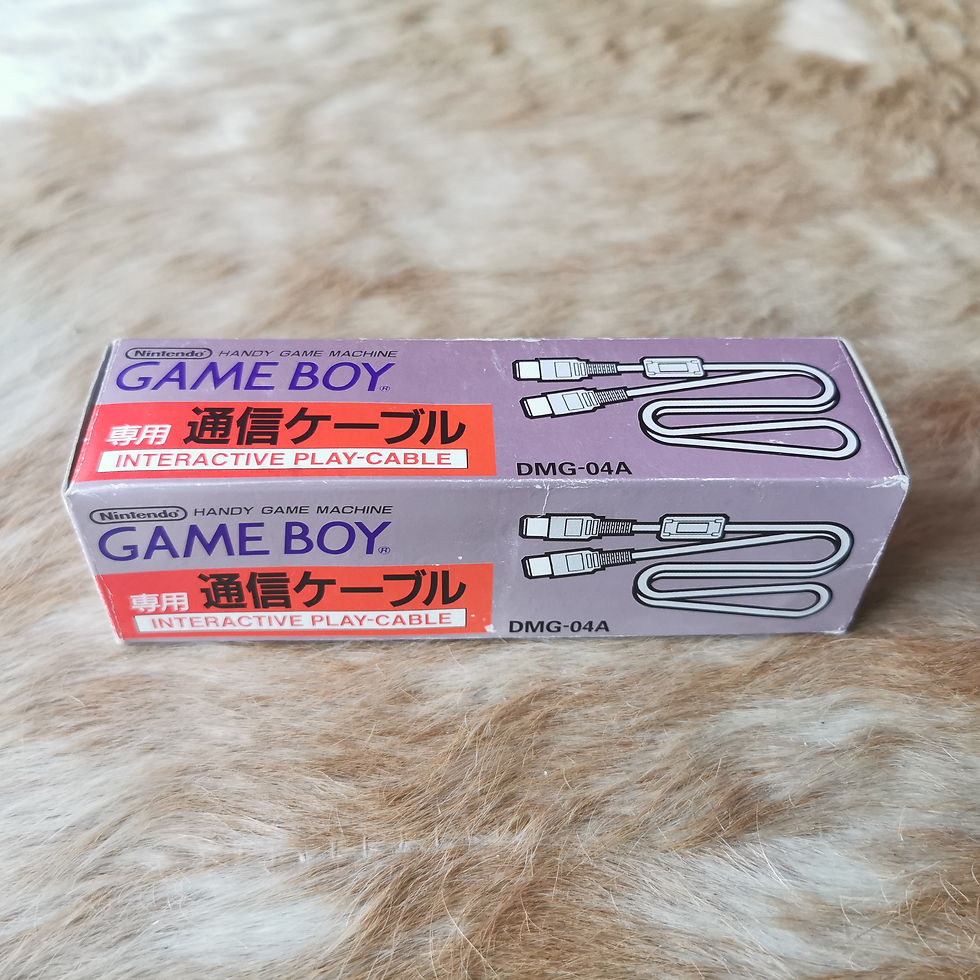
The first version, made for the original 1989 DMG-01, had chunky connectors to match the chunky console. It was the cable that carried the earliest two-player duels, and Nintendo sold it as a simple boxed accessory in every region. You can see the original Game Boy Game Link Cable in the collection. For most owners this was their first taste of playing against a friend on the move.
New Console, New Plug: The Pocket Cable and Adapters
When the slimmer Game Boy Pocket arrived in 1996, Nintendo switched to a smaller, neater link connector. That was tidier, but it created a problem: an old chunky cable would not fit a new console, and vice versa. The answer was a family of adapters and universal cables that could bridge the two generations, letting an original DMG-01 play against a Pocket or a Color. The collection holds both a universal link cable and a console link adapter that solved exactly this mismatch.

Four Players at Once
Two players was only the beginning. Nintendo also made a four-player adapter that let up to four Game Boys join a single game, turning a quiet corner into a miniature tournament. Only a handful of titles supported it, but for those games it was magic, four little screens all showing pieces of the same contest. It is a reminder of how much Nintendo wanted the Game Boy to be a social machine, not just a personal one.

From Tetris Duels to Pokemon Trades
The cable's early fame came from Tetris, whose two-player mode turned quiet commutes into fierce rivalries. But its greatest moment came years later with Pokemon. Trading creatures between two cartridges was not an optional extra; it was the very heart of the game, with some Pokemon obtainable only by trading. Suddenly the humble link cable was essential, the physical thread that connected an entire generation of players to one another. A simple wire had become the backbone of a worldwide phenomenon.
A Small Cable, a Big Idea
It is worth pausing on how forward-thinking this was. The idea that your personal device should be able to connect directly to a friend's, for play and for exchange, is something we now take completely for granted. The Game Boy link cable was an early, tangible version of that idea, made of copper and grey plastic. You can browse the various cables and adapters across the collection, and see how many playground friendships once ran through a single wire.


Comments