
The Game Boy Printer: Nintendo's Sticker Machine of 1998


In the spring of 1998 a child in Japan could take a photo with a Game Boy, draw a moustache on it, and ten seconds later peel it off a roll of paper and stick it on a school bag. Digital cameras still cost a fortune. Home photo printers were a rarity. And Nintendo had quietly put both into a grey plastic box that ran on six AA batteries.
This is part one of our series on the Game Boy Printer. It introduces the machine and the stories around it. Part two opens the lid and explains how it works, part three looks at the games that could print, and part four follows a new cartridge that teaches it an unexpected trick.
Launch: the camera's companion
The Game Boy Printer arrived in Japan on 21 February 1998, together with the Pocket Camera, and reached North America on 1 June 1998. The two were designed as a pair: the Game Boy Camera took the pictures and the printer turned them into something you could hold. The collection holds both the European camera and the Japanese Pocket Camera, alongside the printer itself.
It plugs into the link port, the socket normally used for playing against a friend, and draws its power from six AA batteries of its own. Its design is credited to Hirokazu Tanaka, the Nintendo engineer and composer whose name also appears on the music of games such as Metroid and Tetris. The mechanism inside was built by Seiko Instruments.
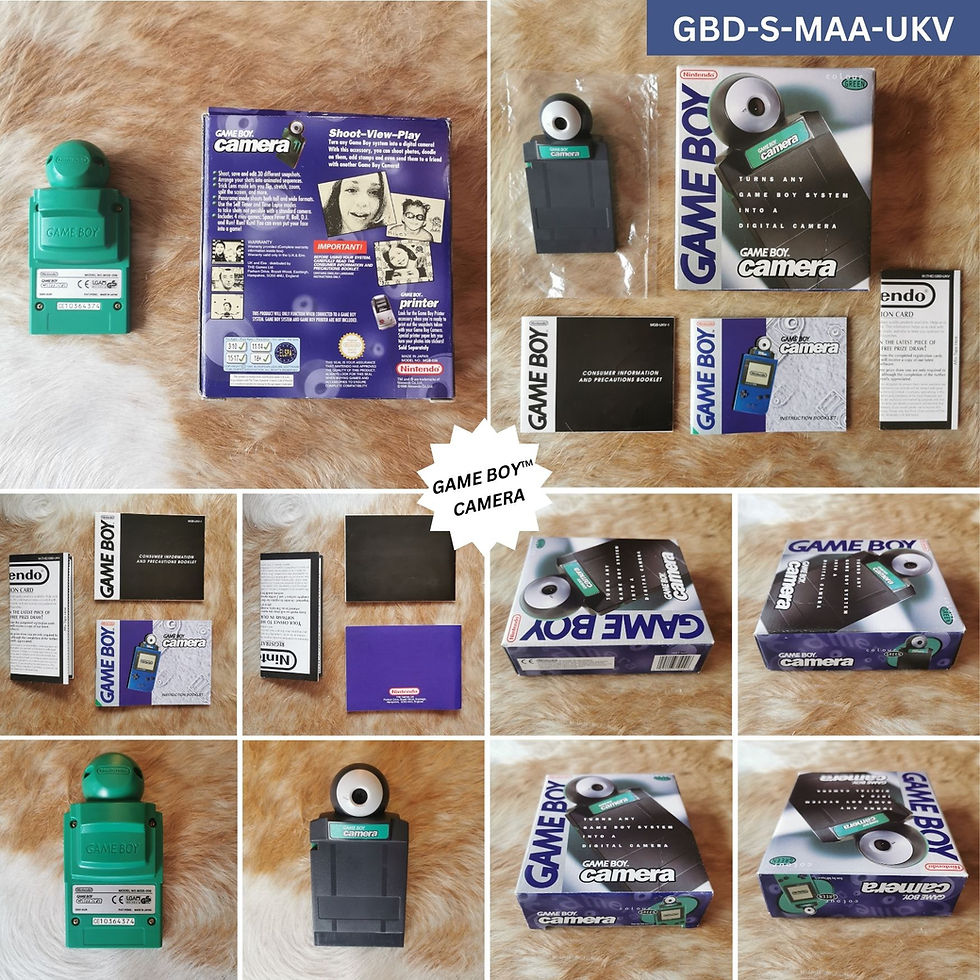
Our earlier article on the Game Boy Camera and Printer tells the story of that pocket photo lab. Here the printer gets the stage to itself.
Printed on stickers
The printer uses no ink. Its paper is thermal paper that darkens where it is heated, with an adhesive back, so every print is a sticker. The roll is 38 millimetres wide, but the picture on it is much narrower: sources give the printed area as roughly two centimetres across, and Nintendo of Europe described a sticker as about 27 by 23 millimetres including its frame.
Nintendo sold the paper in several colours. The collection holds Japanese rolls in white, yellow and blue. A roll gave around a hundred prints, and Nintendo's own material mentions a neat side effect: prints made one after another join into a single long strip, a panorama sticker straight from a handheld.
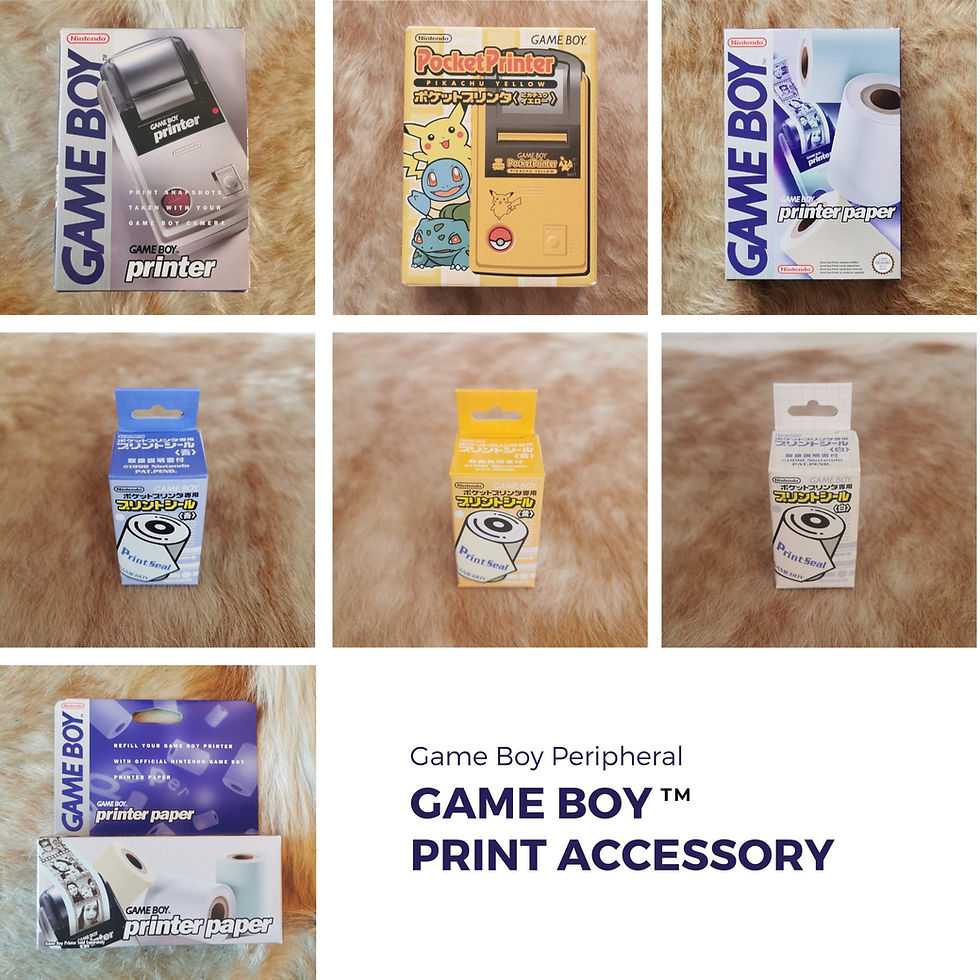
Thermal paper is also the printer's weakness. The same coating that darkens on purpose darkens by accident, through heat, light and age, and the paper has long been out of production. Wikipedia names exactly these two reasons, the impermanence of thermal prints and the missing paper, for why the printer fell out of use.
A Pikachu of its own
On 12 September 1998, the day Pocket Monsters Pikachu, known in the West as Pokémon Yellow, came out in Japan, Nintendo released a matching printer. The Pocket Printer Pikachu Edition is bright yellow, shaped around the famous electric mouse, and was only ever sold in Japan. Inside it speaks exactly the same language as the grey model, so every game that prints works with both.
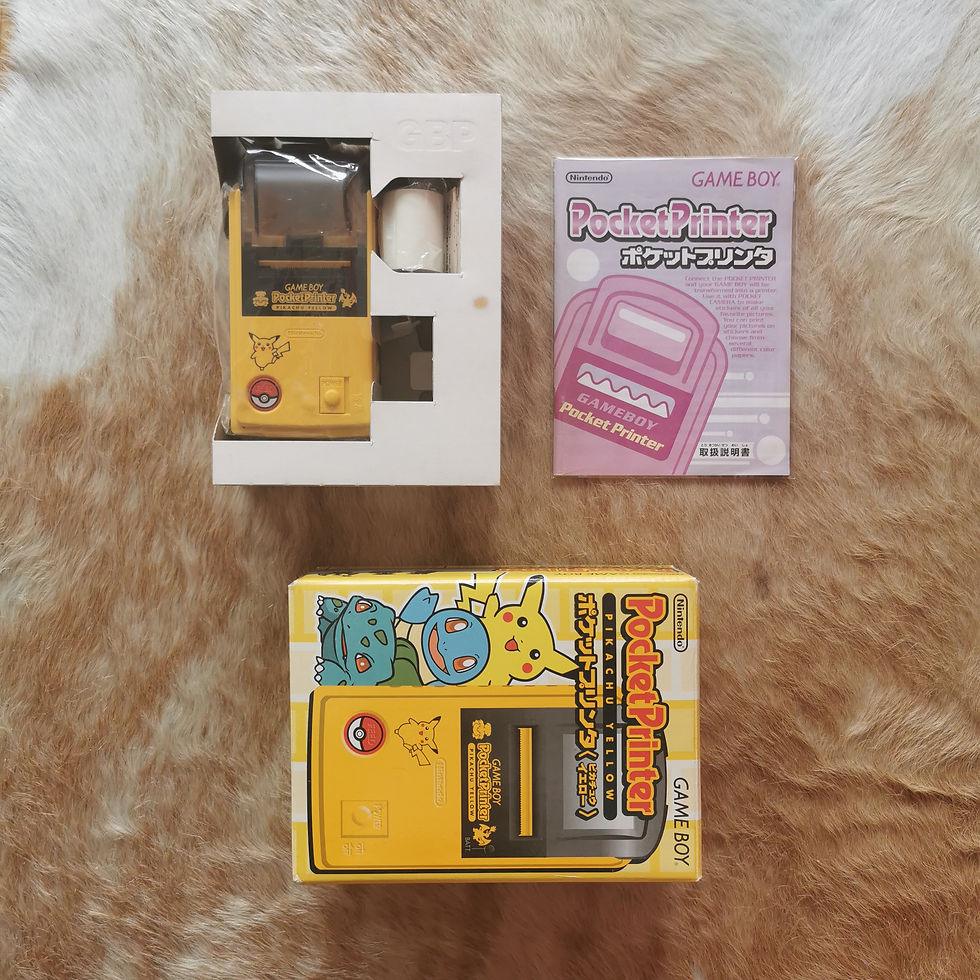
It was not the only character printer planned. A pink Hello Kitty version was announced as well and then cancelled, which makes the Pikachu the only themed printer that ever reached the shops.
When the printer says no
Games that print show numbered error messages, and Nintendo of Europe explained them. Error 1 means the batteries are flat, error 2 a problem with the cable, and error 3 a problem with the paper.
Error 4 is the charming one. It means the room is too hot or too cold to print. A thermal printer depends on precise heat, and outside its comfortable range it simply refuses. Few gadgets have ever complained about the weather.
Game Boy Printer trivia
The print head is exactly 160 dots wide, the same as the Game Boy's screen. That is no coincidence: the printer was built to put a screen on paper, one pixel per dot.
The printer outlived its role inside Nintendo's own ideas. According to Bulbapedia, Satoru Iwata once tried printing Pokémon Snap photos through the Game Boy Camera, found the quality too poor, and the idea turned into the Pokémon Snap sticker kiosks instead.
Where Nintendo re-released printer games on later consoles, the print option is often still in the menu. It just does nothing, a small fossil of a peripheral that no longer exists.
More than a hundred games support the printer, most of them in Japan. Part three of this series sorts out which of them still run on the original DMG-01 and which need a Game Boy Color.
Why it belongs in a collection
The Game Boy Printer is a snapshot of a very specific moment. It was cheap enough for pocket money, simple enough for a child, and it made the Game Boy the first digital camera and photo lab many people ever owned. Complete sets with camera, printer and unopened paper are what bring that moment back, and the paper colours and the Pikachu edition are the kind of details that make a set complete.
In part two we open the lid: a row of 160 heaters, the paper, and the little conversation in hexadecimal that the Game Boy and the printer have every time a sticker comes out.
The Full Series
Part 1: Nintendo's Sticker Machine of 1998 (you are here) · Part 2: How the Game Boy Printer Works · Part 3: Games That Print


Comments