
Hand-Made Prestige: RetroSix and the Art of Restoring a Game Boy


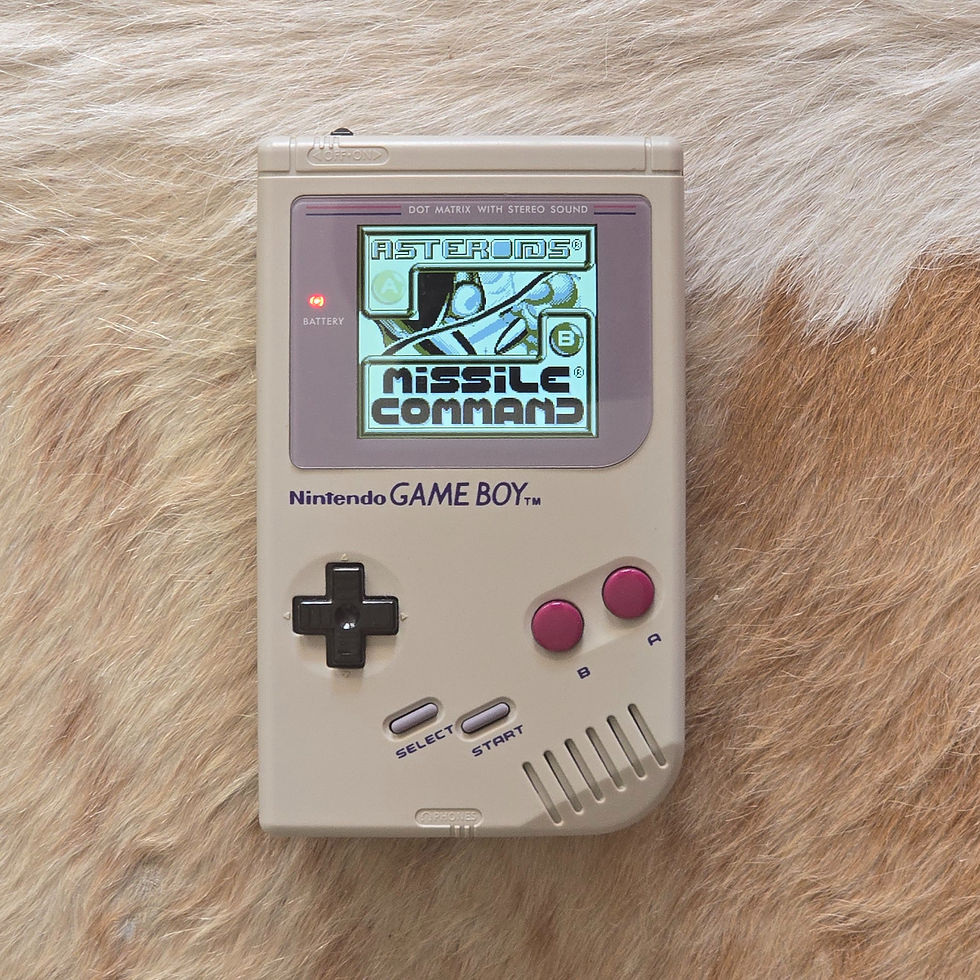
The archive usually preserves the original Game Boy as time left it, patina, honest wear and all, because that history is worth keeping. This piece is the deliberate exception. It is an original 1989 Game Boy, a DMG-01, taken apart and rebuilt from the shell inward by RetroSix, and given to the museum as a single hero piece: a demonstration of just how far a tired grey brick can be brought back. It is catalogued as its own object and credited, with thanks, to RetroSix, whose generosity in building it for the collection the museum is deeply grateful for.
A restoration like this is easy to wave away as a modified console. It is really something closer to a craft. Every part of the original that had aged, the power circuit, the sound, the faint green screen, the yellowing plastic, has been replaced with hardware RetroSix designs and makes itself, and the result still plays the same 1989 cartridges on the same 1989 silicon. The machine is old. Everything around it is new. This feature walks through the build piece by piece, the way the work deserves.
The maker behind the bench
RetroSix is a small, family-run workshop in the United Kingdom, led by Luke Malpass, who has been in the gaming and retail trade since 2013. What sets the shop apart is that it does not simply fit parts bought in from elsewhere. It recreates the moulds of original shells and casts its own from quality ABS, and it designs and manufactures its own boards for power, charging, audio and screens in-house. The stated aim, in Luke's own words, was never the mass market but perfection: "no cheap junk sold for profit."
There is a second side to Luke worth knowing, because it explains the character of the whole project. He also works under the name AngelSix, and through it he gives the knowledge away. The RetroSix Wiki, a free library of install guides, board scans, schematics and capacitor lists, carries the line "made with passion by AngelSix." The products are published open source on GitHub, and there is even a YouTube series on Game Boy development for anyone who wants to write their own code for the machine. It is a rare thing in a repair trade that often guards its secrets: a maker who both sells the hardware and hands out the manual. Luke and his high-end builds have been noticed outside the hobby too, including a 2020 feature by Nintendo Life on building the ultimate Game Boy.
Cast by hand: the shell
The first thing the hand notices is the case. Rather than source a cheap reproduction, RetroSix takes moulds from original shells and casts fresh ones from quality ABS, so the fit and feel are right and the plastic is bright and unyellowed. This particular shell is one of those reproductions, moulded on the back with the familiar legend, down to the model line "DMG-01R". On the front it wears custom buttons, a black D-pad with deep magenta A and B, a small, confident break from the original grey that signals at a glance this is not a standard console. The display sits behind a lens of real tempered glass rather than scratch-prone acrylic.

The heart transplant, board by board
Power that lasts. The original Game Boy ran on four AA batteries and a simple power circuit that, by now, is decades past its best. In this build that is gone. A CleanJuice board sits in the battery bay, a rechargeable USB-C pack that replaces the AA cells entirely; the version fitted here is the 2.2 board, with a USB-C port for charging, an on-board LiPo charger and regulator, and a neat row of test points and indicator LEDs that report battery charge, low battery and the live Game Boy voltage at the press of a button. Alongside it, a CleanPower regulator cleans and steadies the voltage the console actually runs on, which matters more than it sounds: steady, quiet power is the foundation everything else is built on.

A voice at last. The DMG-01's single small speaker was never its strong point. Here the audio has been rebuilt around RetroSix's CleanAmp, a dedicated amplifier board, paired with a far more capable speaker. The difference is not subtle. A machine famous for its thin, tinny chirp suddenly has real volume and a clean, full sound, the kind of upgrade you hear the moment the boot chime plays. Clear audio is something of a house speciality for RetroSix, which goes as far as removing the hum and hiss that plague stock handhelds.
A window reborn. The original reflective screen is beautiful in its own way, but it is dim and needs good light to read. In its place is a backlit IPS display, fitted as a complete new front board, bright and even from edge to edge, crisp at any angle, and here running with a colour palette that makes the old monochrome games glow in a way the 1989 panel never could. It is the single change that most transforms how the console feels to hold and play.

There is a clever touch where the original contrast wheel used to sit. In this build the classic contrast dial is gone, and in its place is a wheel that cycles through the display's colour palettes, letting the old monochrome games be tinted to taste. The panel also brings its own on-screen settings menu: a battery indicator can be shown on the display or hidden, the orientation of the panel can be flipped, and a range of other options can be adjusted, all without opening the console.
The IPS panel's own settings menu, shown on the screen. Where the contrast dial used to be: a wheel that now cycles through colour palettes.
Knowledge kept in the open
It would be fair to admire this console purely as an object, but the reason it belongs in an archive goes a little deeper. RetroSix is one of the operations keeping the original Game Boy not just alive but documented. The free RetroSix Wiki lays out how each of these boards is installed, scans the original circuit boards, publishes the schematics and even lists the correct replacement capacitors, and the hardware itself is open source. That openness is exactly the spirit a museum exists to protect: the grey brick stays repairable, and the know-how to repair it stays in the open rather than dying with the last specialist. A restored console is a lovely thing. A restored console whose every step is written down for the next person is something better.
Why a modern build belongs in a 1989 museum
This archive is devoted to the original Game Boy, and a console with USB-C charging and an IPS screen might look like an odd fit. It is not. Underneath the new boards is the same 1989 machine, playing the same cartridges on the same processor; nothing about the Game Boy itself has been faked or emulated. What has changed is everything that wears out. A piece like this documents the other half of the Game Boy's long life: not the years when it was made, but the years, right now, when people refuse to let it die. It is the grey brick's past and its present in a single object, and the archive is the richer for having one.
You can find their work, and their hand-cast shells and in-house hardware, at retrosix.co.uk, and the open build guides at retrosix.wiki. Thanks to Luke and RetroSix for building this fantastic artwork for the museum.


Comments