
The GB Museum on a Cartridge: A Reference Work That Runs on a Game Boy

Updated: 2 days ago
In A code the Game Boy was never meant to show: a screen showing an object's QR code. Caption: A 1994 invention, drawn by a PC, shown on 1989 hardware, read by the phone in your pocket.

Let me be honest from the start: nobody was waiting for this. The world has many needs, and a Game Boy cartridge with no game inside it was not high on the list. But I run this museum, a project that catalogues everything around the little grey machine, and one day a thought took hold that I could not shake, mostly because it made me laugh. Every object in the collection is a museum piece. So what if the museum itself became one of them? A cartridge that plays nothing, that you slot into a real Game Boy, and that turns the machine into a guide to its own world. An exhibit about the collection, living inside the collection. That is the whole reason it exists. I thought it was a funny idea, and I wanted to see if I could do it.
As it happens, I was not the first person to have the daft idea of a Game Boy that does not play. Back in 1991 and 1992, Nintendo itself sold a small run of cartridges that were not games at all: a Frommer's travel guide, Berlitz translators, a calculator, an address book. The collection keeps seven of these curious little reference carts, from a brief moment when the most famous toy in the world moonlighted as a pocket assistant. So this is really me continuing a tradition, thirty years late and with a much narrower subject: the Game Boy, explaining itself.

A museum you can hold
Switch it on and there are no sprites, no levels, no music to speak of, which I realise is a strange thing to be proud of. What you get instead is the collection itself, reached from one plain menu: Topics, Catalogue, Search, Bookmarks. You can page through 355 of objects, sorted into their categories exactly as they are on the gameboymuseum.com website, reading each one's story a screen at a time. Alongside them I put a small wiki, a proper little encyclopedia of the Game Boy's world that you read chapter by chapter like a paperback: it opens with Origins and Anatomy, works through The DMG Series and its Add-ons, travels Around the World, meets The Makers behind the machine, tours the Games and Studios, and closes with an Afterlife and a Reference section.
GB Musuem on a Cart (DMG-01) GB Musuem on a Cart (DMG-01) GB Musuem on a Cart (DMG-01) GB Musuem on a Cart (DMG-01)
There is a search that runs across the whole lot, and I was careful with one small thing: even an everyday word like game, which appears in almost every entry, still returns its long, honest list rather than pretending it found nothing. A reference that goes quiet on
an obvious word feels broken, and I would rather it be too eager than a liar.

There are also Bookmarks, so you can star the objects you are still hunting for, and the cartridge keeps them in its battery for the next time you switch it on, just the way an old save file used to hold your progress. It runs on a real Game Boy, and if you do not have one to hand, it runs just as happily in a browser.
The Game Boy does not want to be a book
Here is the joke I walked into: a Game Boy is a spectacularly bad e-reader, and it fought me at every turn. The machine can only show 255 little building blocks on screen at once, the tiny tiles it was designed to stack into Marios and mushrooms. Text is greedy with them, because once letters have different widths nearly every line becomes a unique arrangement, and suddenly a page of plain words devours the same budget a whole level of graphics would. My compromise is eight lines of about thirty characters, and the wordiest page in the entire cartridge scrapes in at 251 blocks out of 255. Four to spare. Reading a museum on a Game Boy, it turns out, is a game of inches.
Eight lines of about thirty characters, every letter fighting for a tile. Eight lines of about thirty characters, every letter fighting for a tile.
Even picking a typeface became a small comedy, because on a screen this coarse a font is only as good as its worst letter. One candidate mashed its lowercase m into an n, so number came out as nunber and Game as Gane. Another could not tell c from o, turning screen into soreen and colours into oolours. A third looked crisp and handsome and then turned out to have no lowercase letters at all. The winner was a humble, freely shared pixel font that stands seven pixels tall with a single pixel hanging below the line, which comes to exactly eight, the precise height of one of those stubborn little tiles. Sometimes the right answer is simply the one whose m survives.
How to draw a face without making a skull
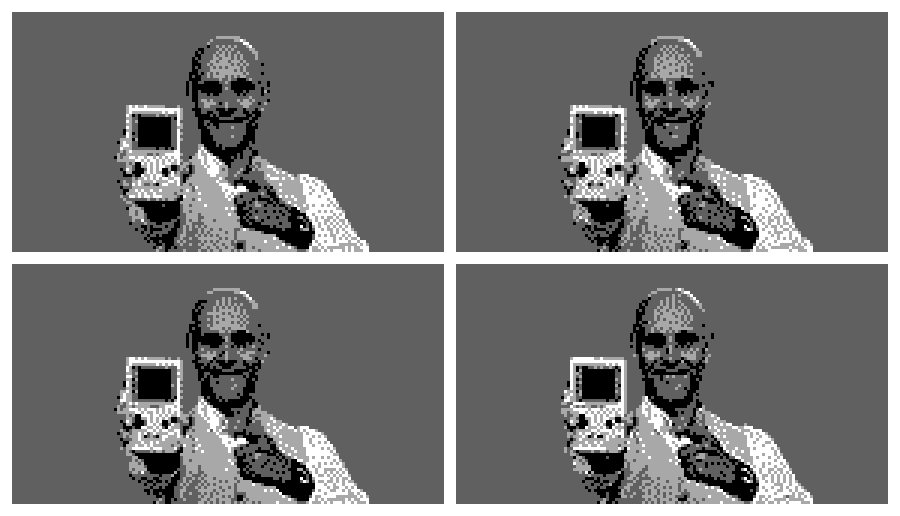
The only picture in the whole cartridge is a small portrait of me, tucked into the credits, and it caused more trouble than anything made of words.

The Game Boy sees the world in four shades of green, and two of the lighter ones sit so close together that if you simply squash a photograph down to those four tones, everything bright collapses into a single flat colour. The face becomes one pale blob, the eyes turn into two black holes, and you have accidentally drawn a skull. It is not a flattering way to introduce yourself. The fix is the same sleight of hand the old Game Boy Camera used.
Rather than judging the photo against the greens, you sort it into even bands of grey first and hand out the colours afterward, and you check the result in plain grey too, because on that cheerful green screen a bad picture can look deceptively fine. Even the background needed thought, since a large flat area only stays smooth in a couple of the available tones and breaks into speckles everywhere else, which is why I ended up sitting on a deep, dark backdrop rather than a soft mid-grey.
A code the Game Boy was never meant to show
Of everything in the cartridge, the part that makes me grin most is the QR codes, because by rights they should not be here at all. When the Game Boy was born in 1989, the QR code did not yet exist. It would not be invented until 1994, and it was created to track parts on a Japanese car-factory floor, not to appear on a monochrome handheld. The Game Boy was never designed to show one, and it certainly was never meant to become a link to a website that would not arrive for another decade. There is something I find quietly wonderful about bolting a piece of the mid-nineties onto a machine from the eighties so it can talk to a phone from today.

Making it work meant respecting what the Game Boy can and cannot do. It has nowhere near the power to build a QR code on the fly, so nothing is generated live on the console. Instead I render every one of the 355 codes in advance on a PC and bake them into the ROM, ready to appear the instant you open an object. There was a fiddly visual catch too: draw the code a shade too large and it dissolves into a mess of one-off tiles that blows the 255 budget again, so each code is sized to snap neatly onto the tile grid and is built from only sixteen repeating pieces. And because a QR code printed onto a cartridge can never be corrected once it leaves my hands, each one points not at a catalogue number, which I might reshuffle one day, but at an object's permanent identity, so the code on the shelf will always lead somewhere real. Point your very modern phone at this very old screen and it jumps straight to the full entry, photographs and all, on the website.
The small stubborn details
The title screen I drew by hand, pixel by pixel, and then coaxed into the cartridge until the machine reproduced it exactly. An earlier, grander version, a whole museum hall with display cases and spotlights, was simply too detailed for the Game Boy to hold, so the screen that greets you now is the leaner, prouder one that actually fit. And yes, there was the obligatory lost evening, the kind every project like this seems to demand, when the whole thing booted to a blank white screen and told me nothing until I finally cornered the cause. That is rather the point of building on hardware this old: it makes you earn every screen, and it does not hand out participation trophies.
So no, the world did not need this, and I make no claim that it did. But I keep coming back to the small joy at the centre of it: a museum object that is itself a museum. The ROM is free to download, and it runs straight in a browser too, but the version I care about is the one on a real Game Boy.
It is a homage to the machine, and a small attempt to keep this knowledge where it came from in the first place, on the Game Boy itself, so that whatever happens to websites and servers and me, the little grey brick can still tell you its own story. You can pick it up over at The GB Museum on a cartridge.


Comments