
Games as Art in the Eternal City: Rome's GAMM Game Museum

Updated: 3 days ago
A few steps from the roar of Roma Termini, in a city whose entire identity is built on art, there is a museum that makes a quietly radical argument with 120 glowing screens: that the video game belongs in that same conversation as the paintings, the marble and the ruins all around it. The GAMM Game Museum is Rome's home for interactive media, and it is one of the more ambitious places of its kind anywhere in Europe.

From VIGAMUS to GAMM
GAMM did not appear from nowhere. It grew out of VIGAMUS, the Video Game Museum of Rome, which opened in 2012 as the first museum in Italy dedicated entirely to video games. That lineage matters. Rome has been taking games seriously as cultural heritage for well over a decade, long before many larger countries got around to it, and GAMM is the next, larger chapter of that effort. The museum is run by Kabuto SRL and carries the kind of credentials that interactive media are still rarely granted: it is recognised as a museum by the Regione Lazio under the national cultural-heritage directives, it has been listed in the regional museum register since 2014, it is entered in the Italian library registry with its own ISIL code, and it is a member of ICOM, the International Council of Museums. In other words, this is not a themed arcade with a ticket desk. It is a recognised cultural institution that happens to be about play.
Seven hundred square metres of interactive history
The museum occupies around seven hundred square metres across two levels, divided into three thematic macro-areas that carry visitors from the origins of the medium through to its most recent evolutions. The scale is deliberately immersive. More than 120 interactive screens, gaming monitors and totems, together with a high-impact LED wall, surround a collection of genuine, unique pieces, so that the history is something you move through rather than something you read about. Consoles and arcade cabinets are switched on and playable, which is the right instinct for a medium you only truly understand with a controller in your hands. Keeping that much hardware running and that many stations working is its own quiet, unglamorous discipline, familiar to anyone who has ever tried to keep old machines alive.
It is also a space built for three audiences at once: families who come to play, enthusiasts who come to look closely, and industry professionals who come to think about where the medium is going. Striking that balance is harder than it sounds, and it is part of what sets a serious museum apart from a nostalgia attraction.
GAMM Museum Rome - Arcade GAMM Museum Rome - It's a me, Mario
Games as a cultural art form
What ties the whole place together is a stated conviction that runs against decades of cultural snobbery: that the interactive medium is a form of art and expression in its own right, worth preserving and presenting with the same care given to any other art. There is a particular weight to that argument being made in Rome, a city whose cultural authority is almost total, and a country whose identity is bound up with the history of art more tightly than almost anywhere else. To stand in the Eternal City and insist that the video game sits in the same lineage as the other arts is not a small claim. It is exactly the claim this field has spent years trying to make, and GAMM makes it on home turf for Western art itself.
The Game Boy's place in the story
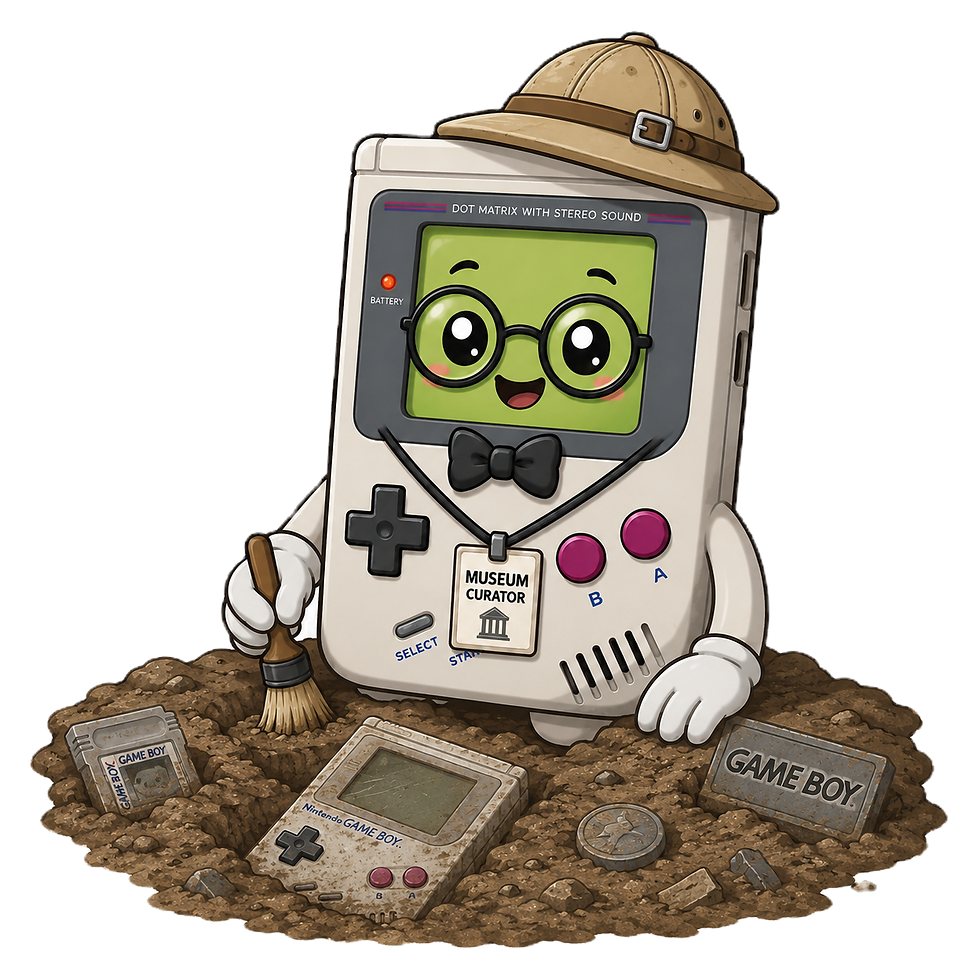
A museum whose three areas trace the medium from its origins to its latest forms almost has to pass through the little grey handheld. The Game Boy arrived in 1989 and did something no console before it had managed: it took the screen out of the living room and put it in a pocket, on a train, under the covers at night. Famously bundled in much of the world with Tetris, it turned a Soviet puzzle game into a global phenomenon and became, for a generation, the first screen that was truly theirs alone.
It is a textbook example of a machine that won not on raw power but on battery life, price and a library people actually wanted, a lesson the industry has relearned many times since. Its unlit, green-tinted LCD and four shades of grey were technically modest even in 1989, yet the original Game Boy and its Color successor went on to sell in the region of 118 million units worldwide, numbers most of its flashier rivals never came close to. In a museum built around the whole arc of interactive media, that monochrome handheld is not a footnote. It is one of the hinges on which the entire story turns.
A kindred spirit in Rome
This is a single-machine archive writing about a recognised national-calibre institution in one of the great art cities of the world, and the scales could hardly be more different. But the conviction underneath is identical: that games are culture, that their history is fragile, and that the best way to honour them is to keep them switched on where people can see and play them. Whether it is seven hundred square metres of interactive history beside Termini or a single grey handheld documented object by object here, the work comes down to the same stubborn idea: that this stuff matters, and deserves to be kept with care.
If you are in Rome
GAMM sits at Via delle Terme di Diocleziano 35/36, moments from Termini station and Piazza della Repubblica, which makes it one of the easiest museum visits in the city to fit into a day. It is open daily, the space is fully accessible, and you can plan a visit or learn more at gammuseum.com. A museum that seats games at the same table as the rest of the arts, and does it in the city that wrote the rulebook for art, is doing exactly the work the rest of us believe in.
Part of our guide to the video game museums worth visiting.


Comments