
The Complete Guide to the Original Game Boy (DMG-01)

Updated: 4 days ago
The original Nintendo Game Boy, model number DMG-01, is one of the most important machines in the history of play. Launched in 1989, the grey brick with the pea-green screen defined portable gaming for a generation and, together with its Color successor, sold more than 118 million units worldwide. It was not the most powerful handheld of its day, nor the prettiest, yet it outlived and outsold every rival by doing a few simple things supremely well: it was cheap, it was tough, and it ran for most of a day on four ordinary batteries.
This guide is the single starting point for the whole DMG-01 story, what it is, how it works, which games it plays and how to collect it, with a link out to a full article on every topic so you can start broad and dive as deep as you like. It also explains how a grey handheld beat the Atari Lynx and Sega Game Gear.

Where It Came From
The Game Boy did not appear from nowhere. It was the product of a company that had reinvented itself many times over, from a maker of hanafuda playing cards into the giant that is Nintendo, and of one engineer's stubborn philosophy. Its designer, Gunpei Yokoi, built it around what he called “lateral thinking with withered technology”: take cheap, mature, well-understood parts and use them cleverly rather than chase the newest and most fragile. That one idea is why the Game Boy could be sold affordably, survive a drop down the stairs and sip batteries while flashier rivals drained theirs in an afternoon. Read the full story of the DMG-01, how a card maker became Nintendo, and why Yokoi's philosophy made the handheld possible; for the arrival itself, see the games that launched the Game Boy.
The Hardware Itself
Take the original apart and you find engineering tuned for one goal: reliable, affordable, all-day play. At its heart is a custom 8-bit Sharp processor, the LR35902, clocked at a modest 4.194304 MHz, with eight kilobytes of work memory and eight more for the screen. That screen is a reflective STN liquid-crystal panel of 160 by 144 pixels showing four shades, and because it is reflective rather than backlit it needs daylight but almost no power. Sound comes from four simple channels, mono through the speaker and stereo through headphones. All of it runs on four AA batteries at six volts for roughly thirty hours. We take the whole machine apart, component by component, in our six-part Game Boy Hardware Explained series, and if you have ever wondered about that unmistakable look, we explain why the Game Boy screen was green. That toughness made it one of the famous survivors that would not die, a machine that even went to space.
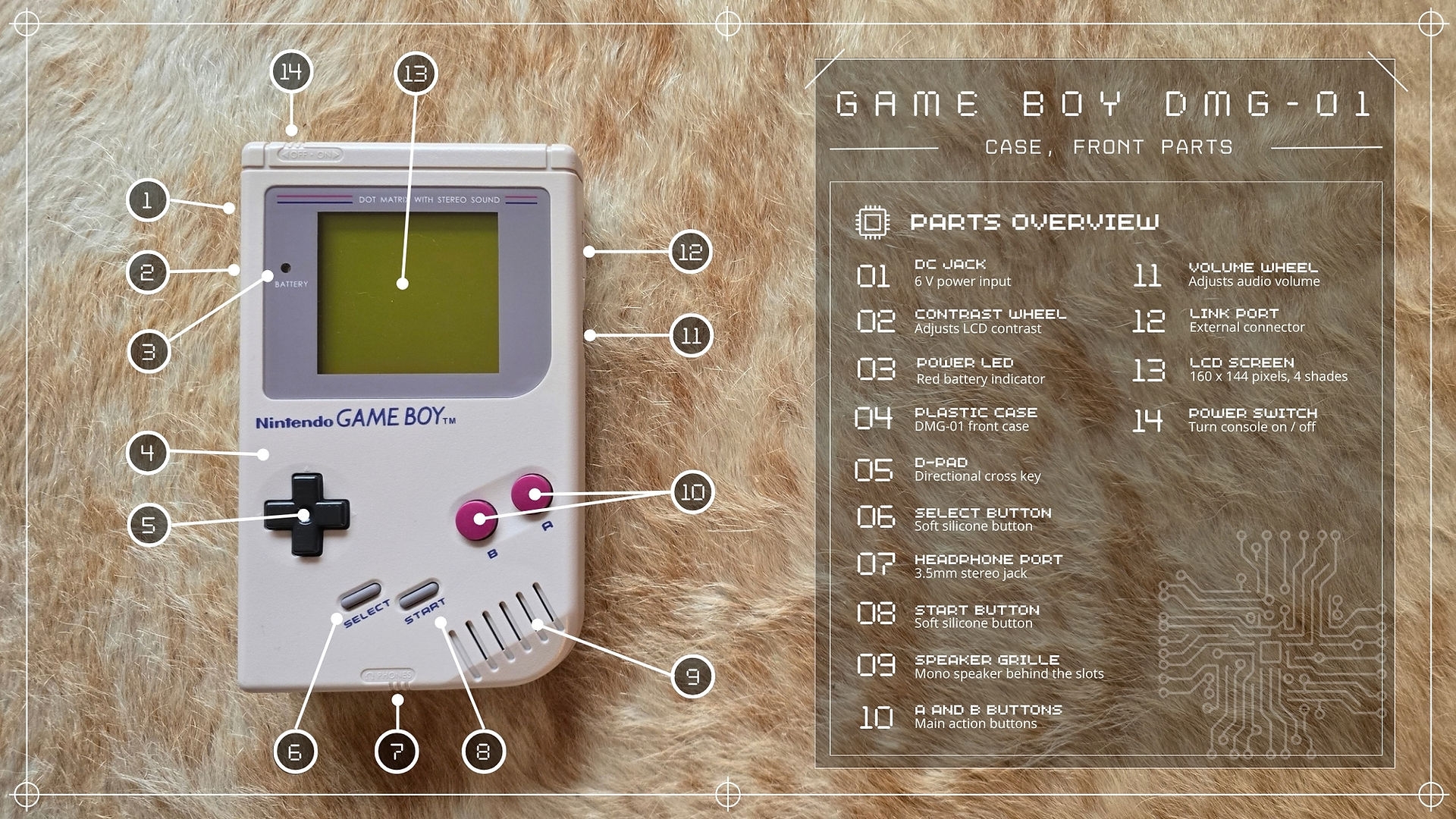
Game Boy Hardware Explained - Front Game Boy Hardware Explained - The Main Board Game Boy Hardware Explained - Backside Game Boy Hardware Explained - LCD Board Game Boy Hardware Explained - Main Board
The Games and the Library
A console lives or dies on its games, and here the Game Boy was unbeatable. It arrived with Tetris in most of the world, a pairing so perfect it sold the hardware on its own, and grew a library that ranged from Super Mario Land and Metroid II to quiet puzzle classics and, late in its life, the phenomenon of Pokemon. We round up the highlights in Classics, Oddities and Hidden Gems and in Great Games, Tiny Screen, and for the short, perfect-for-a-bus-stop titles, see Pick Up and Play. Not every cartridge runs on the 1989 machine, though: our guide Grey, Black or Clear explains at a glance which Game Boy and Game Boy Color cartridges work on a DMG-01 and how to tell them apart. The library itself was the work of many software houses behind the Game Boy.
The Sound
For four thin channels, the Game Boy left an enormous mark on music. Its bleeps and square waves became the foundation of the chiptune scene, and musicians still perform on real hardware today. The whole story, from the boot chime to chart hits, is in The Sound of the Game Boy. It all starts with the famous start-up ping.
Pokemon and the Second Life
By 1996 the Game Boy was seven years old and widely written off. Then two cartridges about catching creatures in long grass turned it into the most wanted machine in Japan, and the trading built into the link cable made owning one a social act. Pokemon gave the ageing handheld a spectacular second wind and remains the clearest proof that the right software can rewrite a console's whole life. The full story, and the museum's Pokemon corner, is gathered in Pokemon and the Game Boy.
Colours and Regional Variants
For six years the Game Boy came in one colour, then it bloomed into a rainbow. See every DMG-01 colour variant explained and the striking European clear and colour collection. The hardware also changed subtly by market, in ports, labels and small design details: our guide to Japanese, European and US Game Boys compared lays out the differences. The range runs from the colourful Play It Loud series to a LEGO Game Boy built from bricks, while the same game often wore different box art from region to region.
Game Boy (DMG-01) - Clear Game Boy (DMG-01) - Blue Game Boy (DMG-01) - Black Game Boy (DMG-01) - Yellow Game Boy (DMG-01) - Green Game Boy (DMG-01) - Red
Reading the Codes
Turn almost any Game Boy over and you will find a code. Two guides unlock them: decoding the DMG model numbers, and a plain-English glossary of the abbreviations every collector should know, from DMG, MGB and CGB to the region tags.
The Companions
The DMG-01 rarely travelled alone. It reached the television through the Super Game Boy, turned into a camera and sticker-printing photo lab with the Game Boy Camera and Printer, and became social through a single grey wire, the story of the Game Boy Link Cable. For the full catalogue of add-ons, from light-and-magnifier units to battery packs and cases, see Every Game Boy Accessory and Peripheral. The story even spans the Game Boy around the world.
Super Game Boy Game Boy Camera (green) Game Boy Printer Game Boy Link Cable
Collecting, Rarity and Value
The Game Boy is one of the most collectable machines there is, common enough to start cheaply yet deep enough to chase for years. If you are beginning, our Collecting the Original Game Boy guide covers where to start, what to check and how to care for a find. To understand prices, What Makes a Game Boy Valuable looks at the factors that move them, and The Rarest and Most Valuable Original Game Boy Treasures shows how far the top end goes.
Playing It Today
A 1989 Game Boy is still a joy to use, and keeping one running in the modern day is easier than you might think. From fresh batteries and screen mods to flash cartridges and modern displays, our guide to how to play and keep one running today walks through the options. You can also play it through emulation or on your TV.
Still Being Built For
Perhaps the most remarkable thing about the Game Boy is that it never really stopped being a living platform. A worldwide community still writes new games, designs new hardware and presses brand-new cartridges for it decades on. Meet the people keeping it alive in The Game Boy Nobody Stopped Making. It will even run a version of Windows.
Go Deeper
This is the overview. Every console, accessory, game and variant mentioned here is documented item by item, with photographs, in the collection. Browse it to put faces to all these names.


Comments