
Grey, Black or Clear: Which Game Boy Cartridges Work on the DMG-01

Updated: 6 hours ago
The original Game Boy, the grey DMG-01 from 1989, has one of the longest-lived cartridge slots in gaming. It kept accepting new games for well over a decade, long after newer and flashier handhelds had come and gone. But not every Game Boy cartridge will run on it, and the clue to which ones do is usually sitting right there in your hand: the colour and the shape of the plastic shell. This guide explains, in plain terms, which cartridges a 1989 Game Boy can play, which it cannot, and how to tell them apart at a glance. Then it takes a tour of the strangest-looking cartridges ever made for the machine, with coloured shells, built-in switches, clocks, sensors and even speakers, many of which still run happily on the original grey brick.
The colour code: grey, black and clear
Nintendo used the colour of the cartridge shell as a simple signal of what a game needs. Learn three colours and you can sort almost any Game Boy cartridge without switching a console on.
Grey cartridges are original Game Boy games. They are the oldest and the most universal: a grey cart plays on every Game Boy ever made, from the 1989 DMG-01 through the Pocket and the Color and right up to the Game Boy Advance. On the DMG-01 they run exactly as intended, in the console's four shades of green-grey.

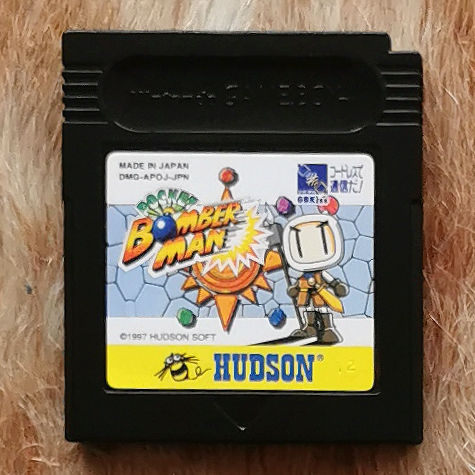
Black cartridges are Game Boy Color games, but the backward-compatible kind, sometimes called dual-mode. On a Game Boy Color they add colour; drop one into the original 1989 Game Boy and it still runs, simply in monochrome. Nintendo chose black on purpose, to set these apart from the grey Game Boy carts and the clear Game Boy Color ones. So a black cartridge is good news for a DMG-01 owner: it will play.
Clear, see-through cartridges are the exception. These are Game Boy Color exclusives, and they will not run on the original Game Boy at all. As a rule of thumb, if you can see the circuit board through the plastic, the game needs a Game Boy Color.
How to tell them apart in your hand
Beyond colour, two physical details give the game away.
The first is the small notch cut into the top corner of the shell. Grey and black cartridges have it; clear Game Boy Color carts do not. That notch is not decoration. On the original Game Boy it works with the power switch: as explained in our hardware series, the DMG-01's power slider pushes a tab into the notch so a cartridge cannot be pulled out while the machine is on. A clear Game Boy Color cart has no notch, so although it slides into the slot, the power switch physically cannot reach the on position, and the console simply will not turn on. It is a mechanical lock-out, not an error message.
The second tell is the extraction grip, the ridged part you pull on. Grey and black carts have a recessed, indented grip. Clear Game Boy Color carts have a raised, bulging grip instead. Once you have felt the difference a few times, you can sort a boxful by touch alone.
There is one famous exception. Kirby Tilt 'n' Tumble, the tilt-controlled Game Boy Color game, was given a notch like an old grey cart, so it slides in and the DMG-01 will switch on. But the game checks the hardware, finds it is not a Color, and politely refuses, showing a screen that says it needs a Game Boy Color to play. And on a Game Boy Pocket, Game Boy Light or Super Game Boy, none of which have the notch lock-out, any clear Color-only cart will power up and show that same message rather than the game.

Super Game Boy, and reading the product code
Two smaller clues round out the picture. Many grey and black carts are Super Game Boy enhanced, which does nothing on the DMG-01 but adds a colour palette and a decorative border when the cartridge is played through a Super Game Boy on a SNES. It is a bonus, not a requirement, so those games still play fine on the original handheld.
The printed product code is the final giveaway. Codes that begin with DMG belong to the original Game Boy era; codes that begin with CGB belong to the Game Boy Color. There is even a neat collector's footnote here: the tilt-sensor cartridge used by Kirby Tilt 'n' Tumble was the last accessory to be given an old-style DMG number, DMG-20, even though it only works on a Color.
The strangest shells in the slot
Compatibility is only half the fun. Some of the most collectible Game Boy cartridges broke the plain grey mould entirely, with coloured plastic, built-in switches, sensors, clocks and even speakers. The lovely part is that because most of this extra hardware lives inside the cartridge rather than the console, a surprising number of them still run on the humble 1989 DMG-01.
Coloured shells. The clearest example is Donkey Kong Land, Rare's 1995 platformer, which shipped in a bright yellow shell rather than the usual grey and is one of the most recognisable original Game Boy carts on any shelf. Pokemon took the idea further in the Non-Japan regions, where the early games were sold in cartridge shells coloured to match each version, so Red, Blue and Yellow each came in plastic of its own colour.
The later Gold and Silver are black dual-mode carts that still run on the DMG-01 in monochrome, while Crystal is the clear, Color-only one that will not. The museum keeps the whole DMG-01-playable run of these games together in its Pokemon corner.

A cartridge with a volume switch. The blue Tamagotchi cartridge, Game de Hakken!! Tamagotchi: Osutchi to Mesutchi, is one of the oddest ever made. It carries a rare Toshiba and Bandai board with a real-time clock, so the pets age by the real calendar even while the Game Boy is switched off, and it has its own built-in speaker with a physical sound on/off switch on the shell.

Infrared cartridges. A small family of Hudson games built an infrared window into the cartridge itself for the GB KISS system, letting two carts beam data to each other with no link cable. Because the infrared hardware sits in the cart, GB KISS works even on the DMG-01. Pocket Bomberman went further still, arriving in Japan in a metal case around a black cartridge, while Pocket Family GB and the Robopon games added a real-time clock and a tiny alarm buzzer that chimes straight from the module.

Sensors and motors. Two accessory cartridges turned the Game Boy into something you shake or feel. The tilt-sensor cartridge holds an accelerometer that reads how you move the console, used by Kirby Tilt 'n' Tumble (this one is Color-only). The rumble-pack cartridge hides a vibration motor powered by its own AAA battery, used by games such as Pokemon Pinball and Perfect Dark, buzzing in your hands when the action calls for it.
Game Cartridge with Rumble Pack Game Cartridge with Tilt Sensor
A cartridge you could rewrite. The Nintendo Power Memory Cartridge was a Japan-only flash cart for a download service: players took it to an in-store kiosk and loaded it with games, up to seven at a time, rather than buying a fixed cartridge. The museum's copy came pre-loaded with Wario Land.

And the camera. The Game Boy Camera, known in Japan as the Pocket Camera, is less a game than a toy, with a rotating lens built into an oversized cartridge, taking greyscale photos you could print as stickers on the Game Boy Printer. It plugs into and works on the original Game Boy too.

The short version
If you remember nothing else: grey plays, black plays, clear does not. The notch and the grip confirm it by touch, the DMG or CGB code confirms it in print, and the handful of clear Game Boy Color carts are the only ones the 1989 machine turns its back on. Everything else, including a remarkable menagerie of coloured, switch-fitted, clock-ticking, rumbling and camera-toting cartridges, is fair game for the original grey brick.


Comments