
Game Boy Hardware Explained: Every Component of the DMG-01


The original Game Boy, model number DMG-01, is a masterclass in doing more with less. Released by Nintendo in 1989, it was already technically behind what home computers and arcades could do, and within a few years its handheld rivals would outgun it on almost every specification that looks good on a box. And yet the Game Boy outsold all of them combined. Understanding why starts with understanding the hardware itself, so here is a component-by-component tour of the machine, followed by a full specification table.
The guiding philosophy was efficiency. Nintendo's engineers, led by Gunpei Yokoi, deliberately chose mature, cheap, low-power components over cutting-edge ones. The result was a console that was affordable to buy, sipped batteries, and survived being dropped, thrown in a schoolbag and generally abused by children. Every technical decision below flows from that same priority.

Component | Specification |
|---|---|
Model number | DMG-01 |
Released | Japan April 1989, North America August 1989, Europe 1990 |
CPU | Sharp SM83 (LR35902), a custom hybrid of the Intel 8080 and Zilog Z80 |
Clock speed | 4.194304 MHz |
Work RAM | 8 KB |
Video RAM | 8 KB |
Display | 2.5-inch reflective STN LCD, 160 x 144 pixels |
Colours | 4 shades of grey (green-tinted screen) |
Sound | 4 channels; mono built-in speaker, stereo through the headphone jack |
Cartridges | ROM cartridge slot; many carts add battery-backed save memory |
Connectivity | Serial link port for the Game Boy Link Cable |
Power | 4 x AA batteries (6 V), up to around 30 hours; DC jack for a mains adapter |
Dimensions | approx. 90 x 148 x 32 mm |
Weight | approx. 220 g without batteries |
The Brain: The Sharp Processor
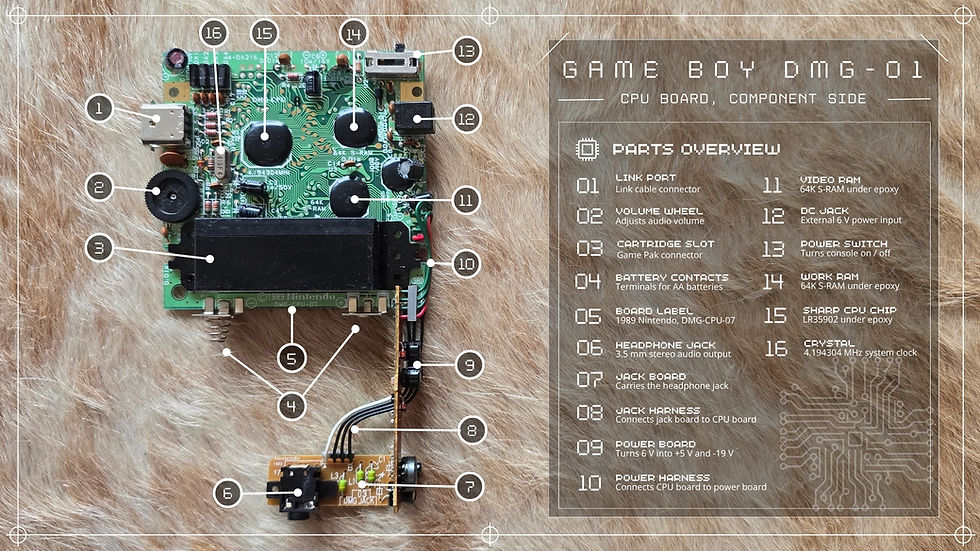
At the heart of the machine sits a custom Sharp chip, the SM83, often referred to by its Sharp part number LR35902. It is a hybrid design that borrows from two famous 1970s processors, the Intel 8080 and the Zilog Z80, without being exactly either. Running at just over four megahertz, it was modest even for 1989, but it was well understood, reliable and extremely power-efficient. Crucially, the chip is a system-on-a-chip: alongside the processor core it integrates the sound hardware, the link-port controller and the picture processing unit, which kept the overall design simple and cheap.
Memory: Small but Sufficient
The Game Boy carries eight kilobytes of work RAM for the running program, plus a separate eight-kilobyte bank of video RAM that feeds the display. By modern standards these numbers are almost comically tiny, but the console never renders a full screen of free-form pixels. Instead it works with small reusable tiles and movable sprites, a clever, memory-frugal approach that let designers build large, colourful-feeling worlds out of a very small pool of graphics data. The cartridge supplied the game code and art, so the console itself needed only enough memory to shuffle it around.
The Screen: Reflective and Battery-Friendly

The famous 2.6-inch screen is a reflective STN liquid-crystal display running at 160 by 144 pixels, capable of showing four shades of grey through its green-tinted glass. It had no backlight, which is the single most criticised feature of the machine and, paradoxically, one of the reasons it succeeded. A backlight would have drained the batteries in a fraction of the time. By making the screen reflective and relying on ambient light, Nintendo traded screen quality for endurance, and endurance is exactly what a portable console needs. The trade-off did leave the display prone to motion blur, or ghosting, on fast-moving games, a quirk every Game Boy owner remembers.
Sound: Four Channels of Chiptune
For audio the Game Boy offers four sound channels: two producing tuneable square-wave tones, one playing back short custom waveforms, and one generating noise for percussion and effects. Out of the built-in speaker the sound is mono, but plug in headphones and you get genuine stereo. Simple as it is, this sound hardware has an enormous cultural afterlife: its distinctive bleeps and buzzes became the foundation of the entire chiptune music movement, and musicians still compose on real Game Boys today.
Cartridges and Saving Your Game
Games arrived on plastic ROM cartridges that slotted into the back of the console. Because the base machine had so little memory, the cartridge did much of the heavy lifting, and more advanced carts included memory-bank controllers to address larger games and, importantly, a small battery-backed memory chip to store save files. That little watch battery inside a cartridge is why a generation could keep a Pokemon or Zelda save alive for years, and why so many collectors today face the ritual of replacing a long-dead save battery.
Connectivity: The Link Port
On the side sits the serial link port, the unassuming socket that turned a solitary toy into a social one. Using the Game Boy Link Cable, two consoles could be joined for head-to-head play and, most famously, for trading. It is no exaggeration to say this humble port shaped gaming history: without it there would have been no two-player Tetris duels and, above all, no Pokemon, whose entire design depends on trading creatures between cartridges over the cable.
Power and the Killer Feature

The Game Boy runs on four AA batteries delivering six volts, and here is where the whole design pays off. On one set of batteries it could run for up to around thirty hours, a figure its more powerful, backlit, colour rivals could not come close to matching. For a machine you actually carried around, that endurance mattered far more than raw graphical power. A DC jack also allowed a mains adapter for play at home. Battery life, more than any single chip, is the specification that won the handheld war.
Build and Ergonomics

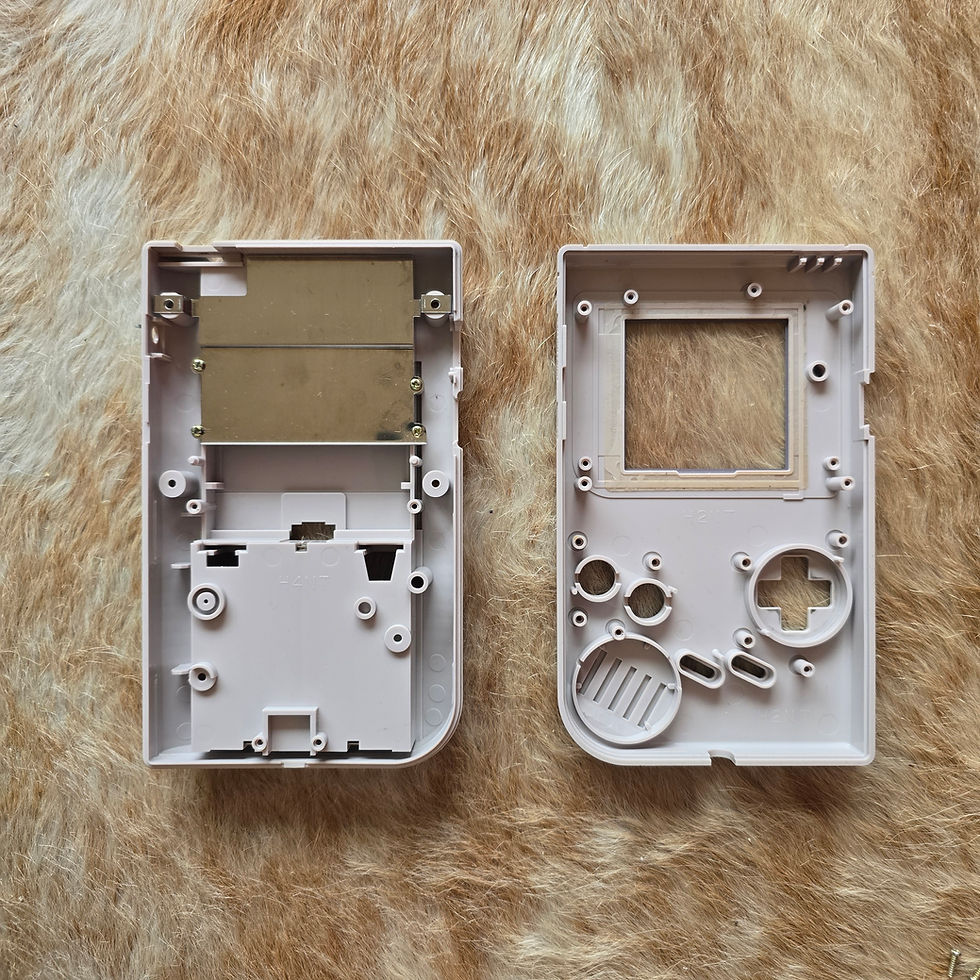
Physically the DMG-01 is a chunky slab, roughly 90 by 148 by 32 millimetres and about 300 grams with its four batteries, carrying the now-iconic layout of a directional pad, two face buttons, and Start and Select. It was built like a brick and famously durable, a reputation cemented by surviving stories of units that endured extraordinary punishment and still switched on. That toughness was not an accident; it was part of the same design philosophy that chose reliability over flash at every turn.

Why the Modest Specs Won
Read the specification table on its own and the Game Boy looks like it should have lost. Its rivals had colour, backlights and more powerful processors. But Nintendo understood that a handheld lives or dies on price, battery life, durability and the strength of its games, not on paper specs. By choosing cheap, efficient, proven components, Nintendo could sell the console affordably, run it for tens of hours on pocket-money batteries, and pour its energy into an unbeatable software library. The DMG-01 is the definitive proof that in hardware design, the smartest specification is the one that fits the job.
The console, its link cable and the cartridges described here are all documented, with photos, in the collection.
The Series
Overview (you are here) · Part 1: The Shell, Buttons and Controls · Part 2: The Main Board and the Sharp Processor · Part 3: The Screen · Part 4: Sound · Part 5: Power · Part 6: Connectivity and the Link Port



Comments