
Pocket Bomberman: A Metal Box, a Black Cartridge and a Secret Infrared Kiss

Some cartridges are unusual before you ever switch them on. The Japanese Pocket Bomberman is one of them. It arrived in 1997 from Hudson Soft, the studio that had looked after Bomberman for years, and it is strange on three separate counts: the way it is packaged, the way it plays, and a feature hidden inside the cartridge that most players never knew was there.
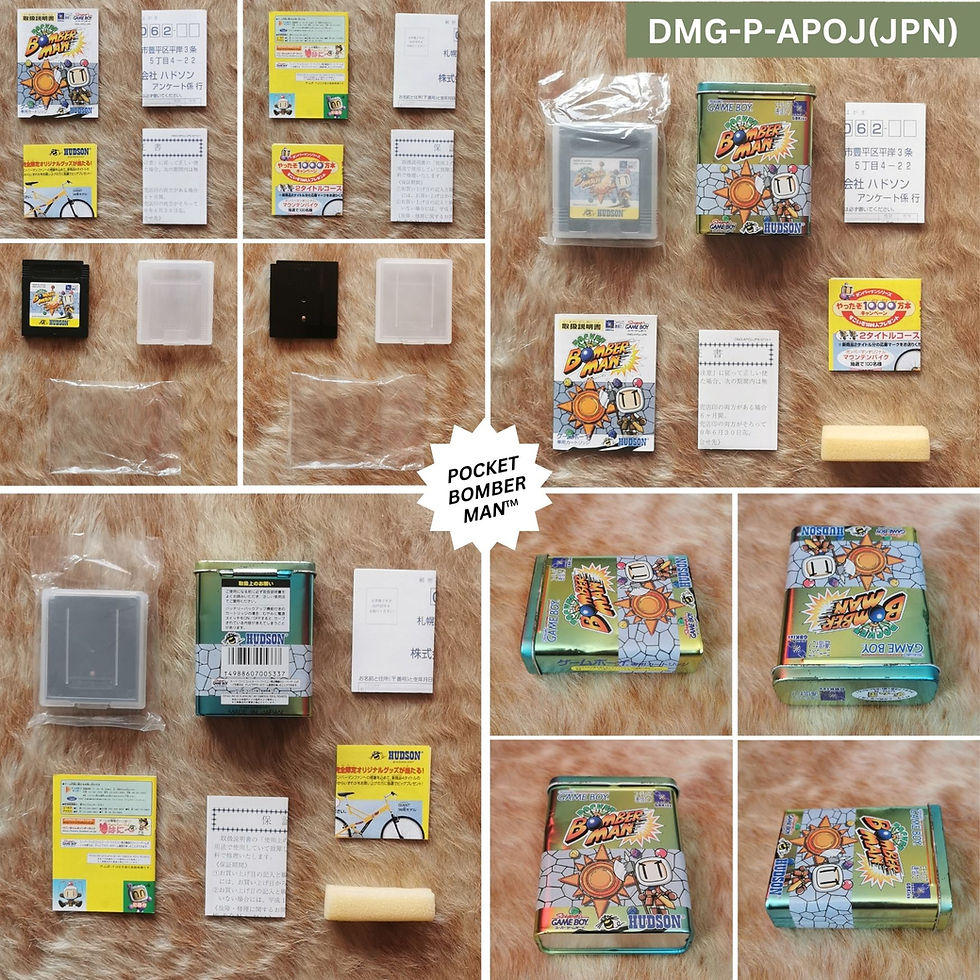
Strange in the hand
Start with the object itself. Where almost every Game Boy game came in a cardboard box with a grey cartridge inside, the Japanese Pocket Bomberman came in a metal case, and the cartridge tucked within it is black rather than the familiar Nintendo grey. In a shelf of near-identical grey bricks it stands out at a glance, and that alone makes it a favourite among collectors who like an object with a bit of physical personality. It is the kind of release you notice from across the room.
A Bomberman that plays sideways
The game is just as much of a departure. For most of its life Bomberman had been a top-down affair, a maze seen from above where you box opponents in and blow up walls to reach them. Pocket Bomberman throws that template out and turns the series into a side-scrolling platformer, viewed from the side as your little bomber runs and jumps through levels rather than plotting across a grid. It is a genuine reinvention of a familiar formula, which makes the cartridge as distinctive to play as it is to hold.
The secret inside: GB KISS
The best surprise is the one you cannot see. Look at the Japanese box and you will find a small logo that most Game Boy owners never encountered: GB KISS. This was Hudson's own infrared system, and it worked in a way that still catches people out. Rather than building the infrared hardware into the console, Hudson put it inside the cartridge itself, on a special chip that carried the infrared diodes right on the board. The console was never part of the equation, which is why a GB KISS game could beam data even on an original 1989 Game Boy, years before the Game Boy Color arrived with its famous built-in infrared port.

In Pocket Bomberman the feature has a lovely use: sharing levels. Bring two cartridges close together, hold the Game Boys almost nose to nose, and players could exchange and pass around their own custom-built maps through the air, with no link cable at all. Hudson named the whole system after exactly that awkward little dance of holding two handhelds together, and the range was tiny, only a couple of centimetres, so a transfer really did feel like a private moment between machines. It is worth noting that this infrared trick lives only on the Japanese Game Boy cartridge; the later international Game Boy Color version of Pocket Bomberman dropped it entirely.
That hidden radio makes Pocket Bomberman more than a curiosity of packaging. It is a working example of one of the Game Boy's strangest capabilities, sitting inside an ordinary retail game rather than a technical novelty. If you want the fuller story of Hudson's infrared and the other ways the handheld learned to reach beyond its own screen, it has a dedicated home in the museum's feature on the Game Boy's talking cartridges.
A metal case, a black cartridge, a series turned on its side and a secret infrared kiss: few Game Boy games pack this many oddities into one release. To see Pocket Bomberman and the rest of the collection, come and explore the Game Boy Museum.


Comments