
Three Cartridges That Taught the DMG-01 New Tricks: Pocket Bomberman, Pocket Family and Robopon

Updated: 5 days ago
Most Game Boy cartridges do exactly one thing: they hold a game. A small, almost entirely Japanese family of them did more. They carried infrared eyes to talk to one another, a real clock that kept running, and in one case an alarm that could wake you. Three of these oddities sit in the collection, or are on their way to it, and all three share two things: they run on the original 1989 DMG-01, and they were built around Hudson's quiet little empire of extra chips.
What ties them together is a system called GB KISS, and the custom chips that made it work. The common thread is worth following, because across these three cartridges you can watch a single idea grow up: from a simple infrared link, to a clock and an alarm, to a full role-playing game, all on hardware Nintendo had already written off as old.
The infrared kiss, and the chips behind it
Hudson introduced GB KISS in 1997. Supported cartridges carry tiny infrared diodes soldered onto the circuit board, so two of them held a few centimetres apart can beam files to each other with no link cable, storing what they receive in the cartridge's own memory. Those files could be game data, extra content or small tools, and the whole system stayed in Japan. I wrote about the trick in more detail in our article on GB KISS.

The hardware came in two flavours, and the difference is the whole story here. The first was the HuC-1: it added the infrared link and memory banking, and nothing else. Its successor, the HuC-3, kept the infrared and added two things the older chip never had, a real-time clock that keeps ticking while the console is switched off, and a small piezoelectric buzzer that can sound an alarm. Line the three cartridges up and you are really looking at those two chips doing progressively more ambitious work.
Pocket Bomberman: where it starts (HuC-1)
The earliest of the three is the Japanese Pocket Bomberman (product code DMG-APOJ-JPN), released on 12 December 1997, with a HuC-1 inside, 256 kilobytes of ROM and 32 kilobytes of RAM. It is an odd object before you even switch it on: the Japanese release shipped in a metal case, and the cartridge inside is black rather than Nintendo grey, so it stands out instantly on a shelf of near-identical bricks.
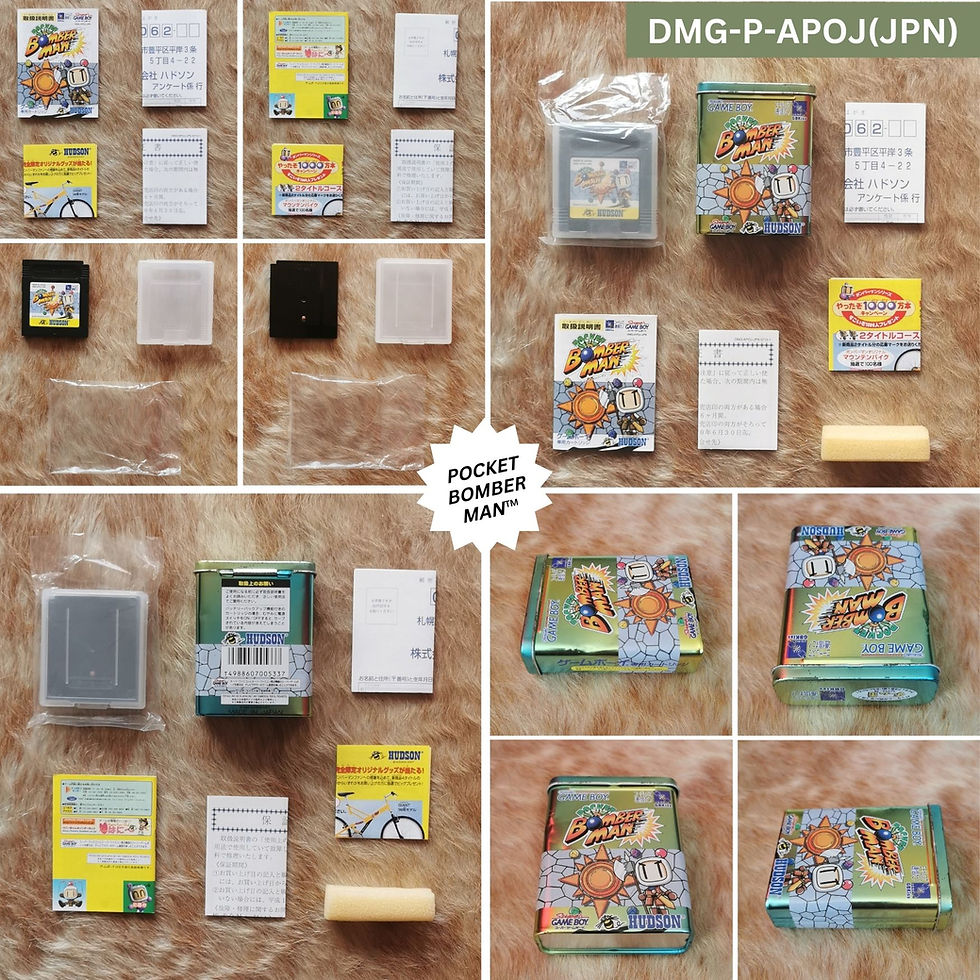
The game is a reinvention too. Bomberman had been a top-down, grid-based affair for most of its life, but Pocket Bomberman turns it into a side-scrolling platformer. The GB KISS feature has a fittingly playful use: players could build their own levels and pass them to a friend over infrared. One warning for anyone hunting a copy: only this Japanese cartridge has the feature. The later international and Game Boy Color versions of Pocket Bomberman dropped GB KISS entirely. And because it runs on the HuC-1, it is the plain member of the family: it can talk, but it cannot tell the time or make a sound of its own.
Pocket Family GB: the full toolkit (HuC-3)
The Pocket Family GB (DMG-HFAJ-JPN, released 9 August 1998) steps up to the HuC-3, with 512 kilobytes of ROM. Developed by Outback for Hudson, it is a gentle household life-simulation, a sort of pocket dolls' house where you furnish rooms and look after the family living in them, with a handful of mini-games and room for up to four families.

It is also the cartridge that actually puts the HuC-3's extras to work, which is what makes it such a satisfying object.
You can set a time and a wake-up alarm, choosing from nine built-in tones, and load further melodies in as GB KISS files; Hudson handed out an extra one called Saita Saita. The same channel could bring in additional characters, and a bundled tool called Family Shot could take a picture of your current family and send it to a Game Boy Printer to come out as a sticker.
A cartridge that keeps time, rings an alarm, receives new content over the air and prints, in 1998, on a nine-year-old handheld. There was a sequel, Pocket Family GB2 in 1999, but it was a Game Boy Color title and quietly dropped GB KISS, the same fate that met the international Pocket Bomberman.
Robot Poncots and Robopon: the same chip, a far bigger game
The third stop uses exactly the same class of hardware for something much more ambitious. The Japanese Robot Poncots games, Sun (DMG-HREJ-JPN) and Star (DMG-HRCJ-JPN), both arrived in 1998 on the HuC-3, with the real-time clock, infrared and full GB KISS support. They are monster-collecting role-playing games, a whole genre away from a puzzle game or a virtual pet, built on the same chip that rang Pocket Family's alarm. An expanded Moon Version followed in 1999.

Here a careful distinction matters, because it is easy to get wrong. The games were marketed as Game Boy Color titles, but Sun and Star are explicitly labelled Game Boy Compatible, so they run on the original DMG-01 as well; their boards are the DMG-UFDT-01 type. Only Sun was ever localised into English, published by Atlus in North America in December 2000 as Robopon Sun. That American release still uses the HuC-3 with its infrared hardware, but it does not support the GB KISS file system, so the Japanese Robot Poncots speak GB KISS and the US Robopon does not. You cannot simply say Robopon has GB KISS without naming the region.

Robot Poncots also makes the clearest use of the HuC-3's alarm of any of these carts: a sensor sits on top of the cartridge for infrared, and the built-in buzzer genuinely chimes from inside the module when certain in-game events come due. There are even reports that it can sound with the Game Boy switched off, which is plausible given that the clock and buzzer draw on the cartridge's own battery rather than the console, though I would want a manual or a period source in hand before stating that flatly.
The three at a glance
Cartridge | Mapper | IR | GB KISS | RTC | Buzzer / alarm |
Pocket Bomberman (JPN) | HuC-1 | Yes | Yes | No | No |
Pocket Family GB | HuC-3 | Yes | Yes | Yes | Yes |
Robot Poncots Sun / Star (JPN) | HuC-3 | Yes | Yes | Yes | Yes |
Robopon Sun (USA) | HuC-3 | Yes | No | Yes | Yes |
A small evolution on one chip family
Lined up together, the three cartridges read like a development log. Pocket Bomberman shows the early HuC-1 and GB KISS: infrared and nothing more. Pocket Family adds the HuC-3 with a working clock and a genuine cartridge alarm, and builds a whole game around using them. Robot Poncots then pours that same HuC-3 hardware into a sprawling RPG, while quietly staying playable on the first grey Game Boy. There is even a melancholy coda to the story: by the time the sequels and the Color era arrived, GB KISS was being left behind, which is why these particular Japanese cartridges are the ones worth keeping. Each is a reminder that a cartridge was never only a game. Given the right chip, it could keep time, talk in the dark, ring an alarm, and still answer to a machine built in 1989.


Comments