
Qix: The Abstract Arcade Classic Where Mario Plays Dress-Up


Some games are remembered for a hero or a story. Qix is remembered for a shape. There is no character to root for, no princess to save, just an abstract, twitching line and a simple, maddening goal: draw boxes and claim the screen before the line catches you. It is one of the strangest hits the arcades ever produced, and the little Game Boy version in the collection hides one of gaming's better-kept jokes, a costume gag from 1990 that Nintendo would dust off nearly thirty years later.
An arcade original from 1981
Qix arrived in arcades in October 1981, made and published by Taito. Unusually, it was not born in Japan at all but came out of Taito's small American division, one of only a handful of games that studio ever produced, alongside the likes of Zoo Keeper. It was designed by a husband and wife team, Randy and Sandy Pfeiffer, which gives this cold, abstract game a rather warm origin story.
First, the question everyone gets wrong: it is pronounced kicks, not quicks, a detail Taito printed right on the original arcade flyer. The concept was so unlike anything else that one writer of the era called it a state of the art Etch A Sketch, and the comparison stuck. That strangeness cut both ways. Qix was a genuine commercial hit and, in Japan, the fifth highest-grossing arcade game of 1981, yet Taito's own director of creativity later admitted it was conceptually too mystifying for gamers, impossible to master, and that once the novelty wore off the game faded. History has been kinder: it is now remembered as a sleeper hit and a real cult classic.
How it plays
The rules are easy to state and hard to survive. You steer a small diamond-shaped marker around a big empty rectangle, and by drawing lines out into open space you fence off chunks of the board. Claim enough of it, usually 75 percent, and you clear the level. The catch is the thing the game is named after: the Qix, an abstract geometric figure that drifts around the middle in constant, unpredictable motion. Touch it while you are mid-draw, before your line closes into a safe shape, and you lose a life.
The Qix is not your only problem. Sparx chase you along the edges of the board, later mutating into Super Sparx that can pursue you down your own unfinished lines. Stop drawing for a moment and a fuse begins burning along the line toward you. Get boxed into a corner and the attract screen has a name for your fate: the Spiral Death Trap. There is real strategy underneath the panic, too. You can draw slowly for double points, and from the third level onward there are two Qixes to deal with, so splitting the board to separate them becomes its own high-risk, high-reward art. It is tense, mathematical and completely unlike the platformers around it, which is exactly why it works so well on a Game Boy in short bursts.
The Game Boy version, and Mario's wardrobe
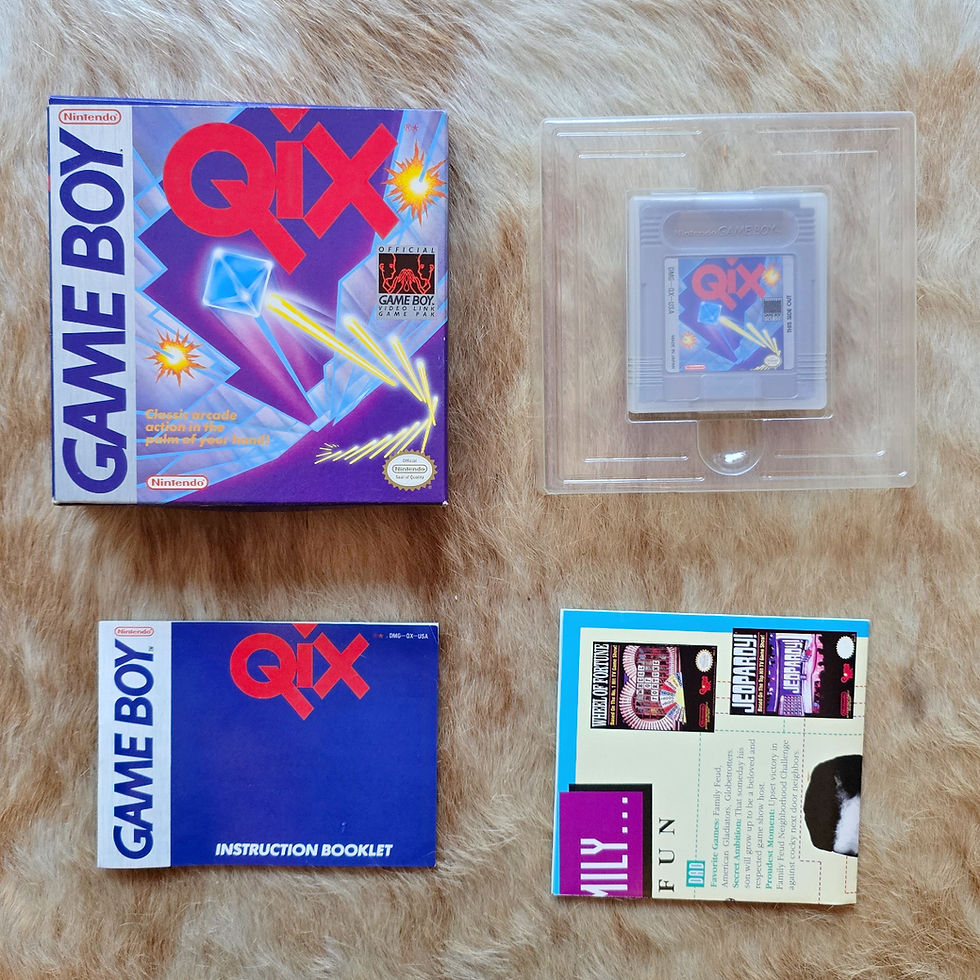
The Game Boy Qix in the collection is the 1990 conversion, developed by Minakuchi Engineering and published by Nintendo. Nintendo did something charming with this cold abstract puzzle: it warmed it up with cameos. Between rounds, depending on how well you are doing, the game cuts to little intermissions starring Mario, and Mario is dressed up. He appears in a whole series of costumes themed around different countries, cycling through outfits before settling back into his familiar red and blue, joined by Luigi, Peach and a few Toads in a proper Mushroom Kingdom scene.
One of those intermissions is the reason Qix earns a special place in Mario trivia. In it, Mario stands in a desert in Mexican dress, playing a guitar while a vulture looks on. That single throwaway scene from a 1990 handheld puzzle game was quietly resurrected in 2017, when the poncho and sombrero returned as a wearable costume in Super Mario Odyssey. A gag most players never saw, hidden in a niche Game Boy port, became an official outfit for Mario a generation later. Reach 500,000 points and the whole gang, Mario, Luigi, Peach and the Toads, turn up to congratulate you, and there is even a two-player versus mode over the Link Cable in which player one is Mario and player two is Luigi.

The game that launched a thousand clones
For a game its own maker thought too strange to last, Qix proved remarkably fertile. It has been named among the ten most cloned video games of all time, spawning a long line of imitators with names like Styx, Xonix and Zolyx. The most notorious descendant is Kaneko's Gals Panic from 1990, which kept the claim-the-area mechanic but revealed pin-up artwork instead of plain colour, launching an entire uncover-the-image subgenre. Taito itself kept the flame alive with a string of sequels and spin-offs, from Qix II and Super Qix to Volfied, and even a later Game Boy Color follow-up, Qix Adventure, in 1999.
That is the quiet greatness of Qix. It has no mascot and no story, just a restless line and a blank rectangle, yet it seeded a whole family of games and smuggled one of Mario's best sight gags onto the Game Boy. To see this copy and the rest of the collection, come and explore the Game Boy Museum.


Comments