
The Puzzle Kingdom: How the Game Boy Ruled the Puzzle Game

Some genres simply belong to certain machines, and the puzzle game belongs to the Game Boy. A handheld you carried everywhere, played in short bursts on a bus or in a queue, and shared with a friend over a link cable was the ideal home for games about clearing lines, matching colours and filling grids. The hardware and the genre fit together so neatly that the result was nothing less than a golden age of the puzzle game, and the Game Boy was its capital city.
The reasons run deeper than convenience, and we will come to them. But first, here is a tour of the puzzle kingdom, built from the cartridges in the collection.
Tetris: The King
It has to start with Tetris. Bundled with the console across the West, the falling-blocks puzzle sold in the region of 35 million copies on the Game Boy alone and turned people who had never touched a video game into obsessives. Its genius was universality: simple enough for anyone to understand in seconds, deep enough to play for a lifetime, and language-free, so it crossed every border effortlessly.
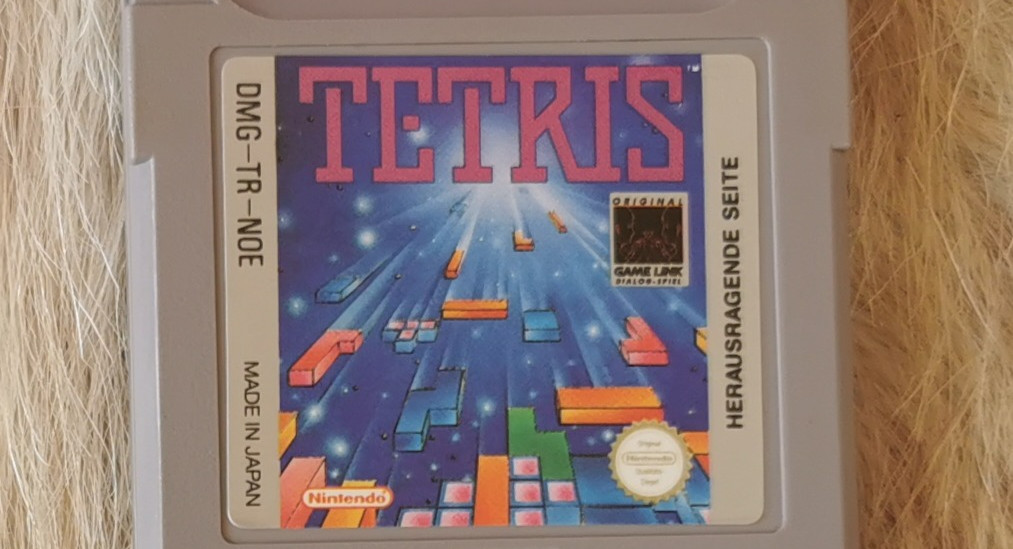
More than any other single game, Tetris defined what the Game Boy was for and who it was for, reaching commuters, parents and grandparents who would never have bought any other game.
Dr. Mario and the Colour-Matchers
If Tetris was about lines, Dr. Mario was about colour. Flinging pills to line up and clear coloured viruses proved just as moreish, and its two-player link mode turned it into a fierce, giggling playground rivalry. It sits at the head of a whole family of colour-matching puzzlers that the handheld encouraged, each one a variation on the same irresistible, tidy-up-the-screen satisfaction. Nintendo understood that lending Mario's face to an abstract puzzle instantly made it approachable, and the formula was copied endlessly across the platform's life.

Picross and the Logic Grid
A different, slower kind of thinking arrived with Mario's Picross, a collection of nonogram logic puzzles in which you chip away at a grid to reveal a hidden picture. Where Tetris rewards fast reflexes, Picross rewards patience and deduction, and that quieter pleasure built a devoted cult following that endures today. It is a favourite among collectors precisely because it represents the thoughtful, unhurried end of the puzzle spectrum, proof that the genre on the Game Boy was far broader than falling blocks alone.

The Competitive Edge
What often gets forgotten about the Game Boy puzzle boom is how social it was. The link cable turned solitary time-killers into head-to-head duels, where clearing your own lines could send trouble cascading onto your opponent's screen. Two players hunched over a cable, each with their own console and cartridge, was one of the defining images of the era, and it gave these simple games a competitive depth that kept them on playground desks for years. The puzzle game on the Game Boy was never only a way to pass time alone; it was also, quietly, one of the platform's first great multiplayer genres.
Ports and Oddities
The kingdom had its imports and its curiosities too. Lemmings brought its beloved, brain-bending rescue puzzles to the small screen, asking you to guide hordes of hapless creatures to safety, while Pocket Bomberman turned the maze-and-bombs formula into pocket-sized strategy. Japan even produced dedicated brain-training puzzlers like Atama wo Yawarakaku Suru, whose title translates roughly as softening up your brain, years before that whole genre became a worldwide fad on later Nintendo hardware. The breadth on display is remarkable, and much of it never left Japan.
Lemmings
Why the Game Boy Was Made for Puzzles
There is a neat logic to all of this. The Game Boy's greatest strengths, its portability, its famously long battery life, its short pick-up-and-play sessions and its simple two-button control scheme, are exactly the qualities a great puzzle game needs. A puzzle does not require detailed graphics or a big screen; it requires a clear grid and an instant restart, both of which the hardware delivered perfectly. The console's technical limitations, so often lamented for action games, were no limitation at all here. The genre and the machine were made for each other.
That is also why the puzzle shelf holds up so well decades later. These are the games people never really stopped playing: a good puzzler ages far more gracefully than a technically ambitious action game, because its appeal was never about spectacle in the first place. The design was the whole point, and good design does not date.
The Most Rewarding Shelf to Collect
For a collector, the puzzle corner is one of the most satisfying to fill. It runs from the most famous game on the entire platform down to obscure Japanese oddities that most players outside Japan never knew existed, which means it offers both the cornerstone pieces and the deep-cut rarities. And unlike much of the library, every one of these cartridges is still genuinely, dangerously playable, which is rather the point.
Every puzzle game named here is documented, with its packaging where complete, in the collection.


Comments