
The Tamagotchi Cartridges: Three Pet Sims, and One of the Rarest Boards in Game Boy History

Updated: 11 hours ago
In 1997 you could not walk past a schoolyard in Japan without hearing a Tamagotchi beep. Bandai's little egg-shaped virtual pets were a genuine craze, and like every craze of the age it spilled onto the Game Boy. Under the banner Game de Hakken!!, which means roughly "Discover it in a game!", Bandai turned the keychain pet into a full handheld experience. Three of these Japan-only cartridges now sit in the collection, and while they look like near-identical merchandise tie-ins, one of them hides one of the strangest circuit boards ever fitted inside a Game Boy cartridge.
That is the fun of a set like this. On the shelf they are small boxes of a licensed children's game. Open them up, and two are ordinary Game Boy cartridges doing a charming job, while the third is a genuine piece of hardware trivia that still trips up emulators today. All three run happily on the original 1989 DMG-01, so there is more going on here than the cartoon artwork lets on.
Osutchi to Mesutchi (DMG-AOMJ-JPN) Tamagotchi 2 (DMG-AT3J-JPN)
Bandai did not stop at one. The first Game de Hakken!! Tamagotchi reached the Game Boy in 1997, Tamagotchi 2 followed later the same year, and Osutchi to Mesutchi arrived in early 1998, each leaning a little harder on the handheld than the simple keychain toy ever could. At the height of the craze Bandai was shifting the little eggs by the tens of millions, so a Game Boy spin-off was less a gamble than a certainty.

The first Tamagotchi: the pet sim at its purest
The newest addition to the collection is the oldest of the three games: the original Game de Hakken!! Tamagotchi, which reached Japanese Game Boys in 1997, a few months before Tamagotchi 2. It is the purest of the set, sticking closest to the keychain toy that started the craze. You hatch a single pet from its egg and raise it to adulthood, feeding it, playing with it, disciplining it, healing it when it falls ill and cleaning up after it, with a couple of extra stats such as stress and selfishness nudging how it turns out. The one thing it does not do is keep real time: there is no clock in the cartridge, so instead the game lets you choose how quickly your Tamagotchi ages in the options. It is a conventional Game Boy cartridge with none of the special silicon that makes its Osutchi to Mesutchi shelf-mate so unusual, and it runs on the original DMG-01 like the rest. Having all three side by side is what makes the contrast so clear: two ordinary carts doing a charming job, and one quietly carrying a tiny computer's worth of extra hardware.
Tamagotchi 2: the pet sim, grown into a world
Game de Hakken!! Tamagotchi 2 (DMG-AT3J-JPN), arrived on 17 October 1997, and it is a sequel that does what good sequels do, which is add room to roam. Rather than just tending a single pet on a blank screen, you control a character called Mikachu around a small village: you search the bushes, trees and rivers for eggs, visit other houses, and talk to Professor Banzo. Mikachu's home has both a bug tank and a fish tank, so you can keep two pets at once, a forest (Mori) type and an ocean (Umi) type.
Alongside the caretaking there are three minigames, and they are more charming than they need to be: a guessing game where a heart hides under one of twelve sand-covered cells while a skull waits to cost you a point, and a maths game with three difficulty levels where you help your Tamagotchi with its sums. The creatures introduced here went on to appear in later Bandai titles such as Mori de Hakken and Tamagotchi Ocean. On a Super Game Boy the game dresses the screen with a few of its own borders. It is, in short, a thoroughly ordinary and thoroughly likeable Game Boy cartridge, which is exactly what makes its shelf-mate so surprising.
Osutchi to Mesutchi: the special cartridge
The third box is Game de Hakken!! Tamagotchi: Osutchi to Mesutchi (DMG-AOMJ-JPN), released on 15 January 1998, developed by Tom Create for Bandai. It is built on the real-world Osutchi and Mesutchi toys, the male and female Tamagotchi units that could be clipped together so the two pets could marry and have offspring. The game leans into that idea: it starts by asking you to set the date and time, then has Mikachu choose one of three eggs, and from there you raise a male and a female and pair them up.
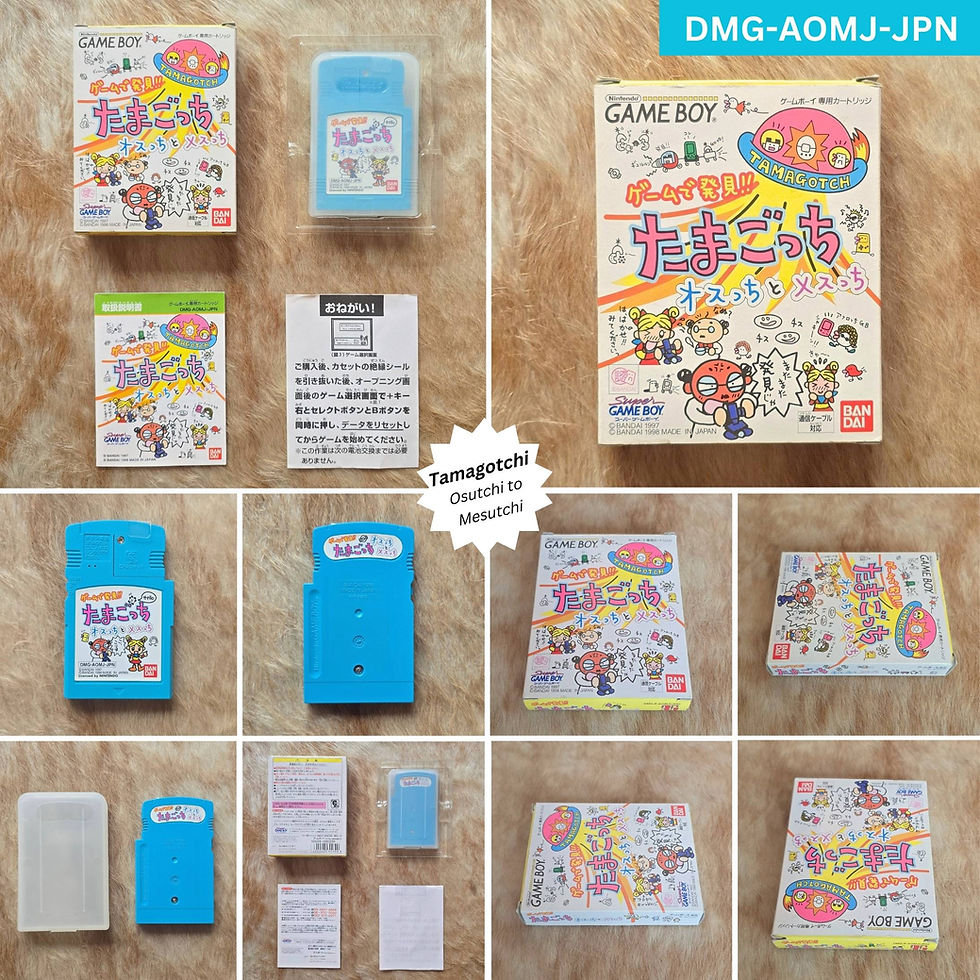
Asking for the clock at start-up is the first clue that this is no ordinary cartridge, and the board inside confirms it. Where almost every Game Boy game used one of Nintendo's standard memory controllers, Osutchi to Mesutchi carries custom Toshiba and Bandai silicon: a mapper known as the TAMA5, a TAMA6 microcontroller alongside it, and a separate TC8521AM real-time clock chip, sitting alongside the game's mask ROM. The point of the clock is that your Tamagotchi age in real time, growing and needing care by the actual calendar rather than by play sessions, even while the Game Boy is switched off. The cartridge even has its own built-in speaker, with a physical sound on/off switch on the shell, so the pet chirps and sounds its alerts straight from the module, not only through the Game Boy.

What makes this a collector's curiosity rather than a footnote is how rare that hardware is. The TAMA5 was a one-off: no other Game Boy game ever used it. Its unusual command interface and its real-time clock meant that for years cartridge dumpers struggled to read it correctly and emulators could not run it at all, and proper TAMA5 support only arrived in a handful of emulators relatively recently. A gentle pet game aimed at children turned out to be one of the most awkward cartridges in the entire Game Boy library to preserve, which is precisely the sort of contradiction this museum enjoys. Among collectors and emulator developers the TAMA5 has become shorthand for an awkward board, the kind you only hear about when someone is trying to make an old game run again.
The two side by side
Tamagotchi | Tamagotchi 2 | Osutchi to Mesutchi | |
|---|---|---|---|
Released | 1997 | 17 Oct 1997 | 15 Jan 1998 |
Cartridge hardware | Standard | Standard | TAMA5 mapper, TAMA6 MCU, TC8521AM RTC |
Real-time clock | No | No | Yes |
Built-in speaker | No | No | Yes (sound on/off switch) |
Why a set like this earns its place
Taken together, the three cartridges tell a small story about how far a licensed tie-in could go. The first Tamagotchi and Tamagotchi 2 show the comfortable version: well-made pet simulators running on standard hardware, one of them adding a village to explore and minigames to pass the time. Osutchi to Mesutchi shows the ambitious version, reaching for a real-time clock and a bespoke mapper so that a virtual family could live and grow on its own schedule. All three are Japan-only and all three play perfectly on the first grey Game Boy. Two are lovely period pieces; the other is a genuine piece of Game Boy hardware history hiding behind some very cheerful cartoon artwork.



Comments