
The Game Boy's Hidden Powers, Part 6: Making Music

Slide a cartridge into a Game Boy and you expect a game. Sometimes you get a synthesizer instead. This is Part 6 of our short series on the hidden powers of that little slot, and this time the cartridge does not want you to play. It wants you to perform.
A groovebox in your pocket
Nanoloop is a music sequencer and synthesizer that lives entirely on a Game Boy cartridge. It was created by the Hamburg artist and musician Oliver Wittchow and began circulating at the end of the 1990s. Instead of levels and enemies you get a grid, four buttons and the console's humble sound chip, which turns out to be a surprisingly capable little instrument. The NL13 unit in our collection sits in a plain third-party shell moulded only with the word GAME, a silver nanoloop label on the front and PAT. PEND. stamped on the back, exactly the kind of unassuming object that hides a whole studio.

There is no laptop, no audio interface and no mixer in sight. You compose on the same four buttons and directional pad you would use to jump over a Goomba, saving your patterns to the cartridge's own memory and listening through the built-in speaker or the headphone jack. That portability was the whole point. A studio that fits in a coat pocket and runs on a pair of AA batteries changes when and where music gets made.
What makes nanoloop remarkable is not just that it makes sound, but that it makes music you would actually want to hear. Alongside Little Sound Dj, it became a cornerstone of the emerging chiptune scene, the movement that took the bleeps and buzzes of 8-bit hardware and treated them as a serious palette rather than a novelty. Musicians carried Game Boys on stage. The handheld Nintendo built for Tetris quietly grew a second life in clubs and bedrooms.
That scene still thrives today. Netlabels, live shows and a steady stream of new releases keep the format alive, and for many artists the entry point is exactly this: a second-hand Game Boy and a nanoloop cartridge. Few instruments so cheap have inspired so much.

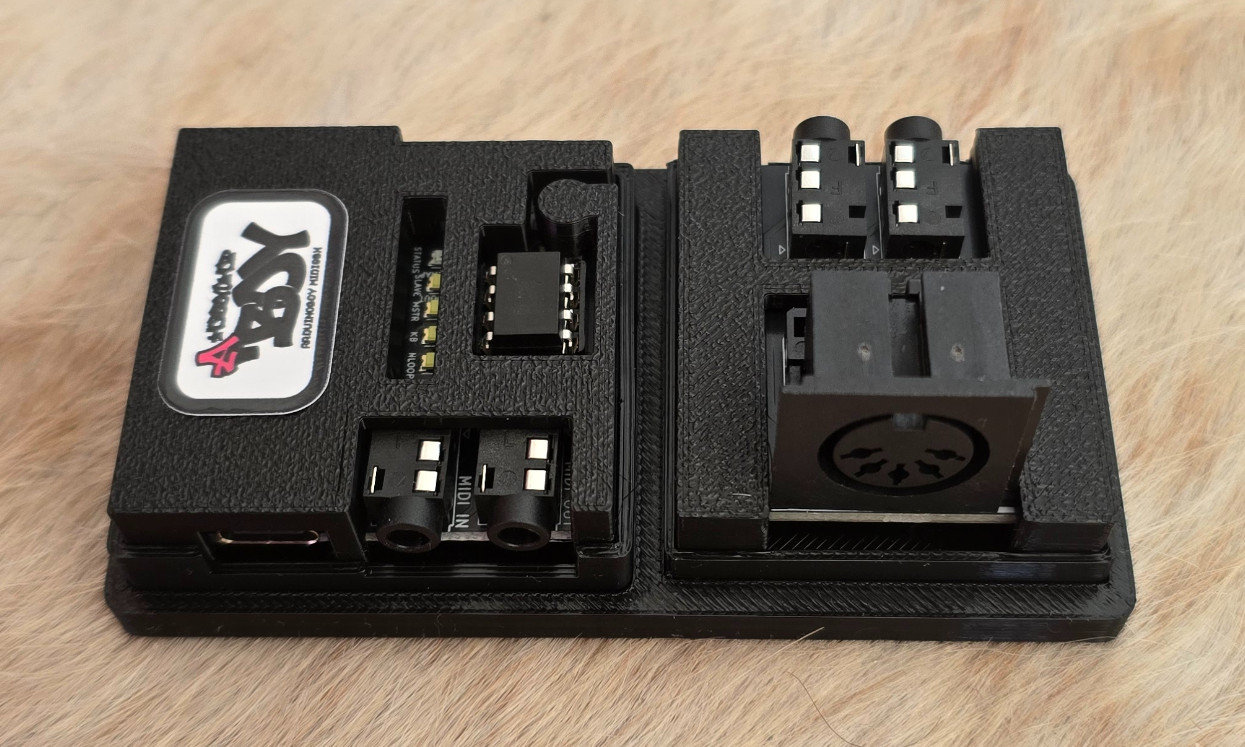
The story did not end with self-contained sequencers, either. Makers are still building new music hardware for the Game Boy today, from drone cartridges like Droneboy to MIDI bridges like the Arduinoboy, which lets the handheld lock to a modern studio or run the mGB cartridge and behave like a MIDI sound module. We feature one of those makers, HobbyChop, in the Journal.
Why the Game Boy sounds the way it does
The Game Boy's audio hardware gives you a handful of channels: two pulse waves, a programmable wave channel and a noise channel for percussion. It is a tight set of ingredients, and that constraint is exactly why chiptune has such a distinctive character. Nanoloop hands those channels to you directly and lets you sequence them step by step, so the same chip that chirped when Mario grabbed a coin can lay down a bassline, a lead and a beat at once.
None of this required Nintendo's blessing. Nanoloop is an unlicensed release, made outside the official system by someone who simply saw the potential in the hardware and built the tool he wanted. That independent spirit is stitched through the whole chiptune story.
We are keeping this chapter deliberately short, because the full story deserves more room than a signpost can give.
If you want the deep dive, we have written it. Our full series The Sound of the Game Boy follows the handheld's journey from simple sound effects to a genuine musical instrument, with nanoloop at the centre of the story. Start there for the history, the hardware and the artists who made it sing.
You can also meet the NL13 and the rest of the collection over at the Game Boy Museum. Every cartridge has a hidden power. This one just happens to have rhythm.
The Full Series
Part 1: A Sense of Movement · Part 2: Eyes and Ears · Part 3: Talking Cartridges · Part 4: A Bigger Memory · Part 5: Cheat Modules · Part 6: Making Music (you are here) · Part 7: Getting to Work · Part 8: Every Game at Once


Comments