
Arduinoboy Pro, the Game Boy Goes MIDI

Updated: Sep 11
A 1989 handheld was never supposed to end up patched into a modern studio, blinking in time with a laptop and a rack of synthesizers. Nobody at Nintendo drew that on a whiteboard. Yet here it is on the bench: a Game Boy, a five-pin MIDI cable, and a small black box that quietly makes the two speak the same language. The box is an Arduinoboy Pro, and it is the newest music curiosity to join the collection.
The Arduinoboy Pro is an open-source interface that connects the Game Boy to MIDI, and it turns the grey brick into something it was never sold as: a real, syncable instrument that slots into a rig full of gear built decades later.

From a link cable to a MIDI cable
The whole trick starts at the link port, the little connector on the side of the Game Boy that Nintendo intended for two-player Tetris. The Arduinoboy plugs into that port and can even draw its power from the console, so there is no wall wart and no extra battery to babysit. On the other side sits a standard five-pin DIN MIDI socket, the same connector that has tied studios together since the early 1980s. Between the two lives an Arduino, the open hardware platform that gives the device its name.
The concept is the work of Timothy Lamb, better known in chiptune circles as trash80. Because the whole design is open source, it has been built, tweaked and re-boxed by makers all over the world for years, which is part of why it has become a small standard in the Game Boy music scene.

One button, several modes
A single push button cycles the Arduinoboy through its modes, and each one teaches the Game Boy a different trick. In the most common one it slaves a Game Boy running Little Sound Dj, the legendary tracker better known as LSDj, to an external MIDI clock or a DAW. That means the handheld starts, stops and stays in time with everything else on the session, with control over the sync resolution and over MIDI start and stop. There is a dedicated LSDj MIDIMAP mode as well, and a mode that syncs Nanoloop, the other great Game Boy music tool.
Nanoloop players can point the same box at their cartridge, and if you want to see where that software lineage leads, the museum already documents the pocket-sized Nanoloop NL13 elsewhere in the hardware guide.
There are several modes in all, around seven depending on how you count them, and the beauty is that switching between them is a matter of one thumb and a blinking light rather than a menu dive.
mGB: the Game Boy as a synth
The mode that tends to make people lean in is mGB. mGB is a Game Boy cartridge program, also written by trash80, that turns the console into a MIDI-controlled sound module. Load the cartridge, connect the Arduinoboy, and the Game Boy stops being a self-contained music box and becomes a voice you play from a keyboard, a sequencer or a DAW. It hands you full control of the console's sound hardware: the two pulse channels, the wavetable channel and the noise channel that together define the Game Boy's voice.
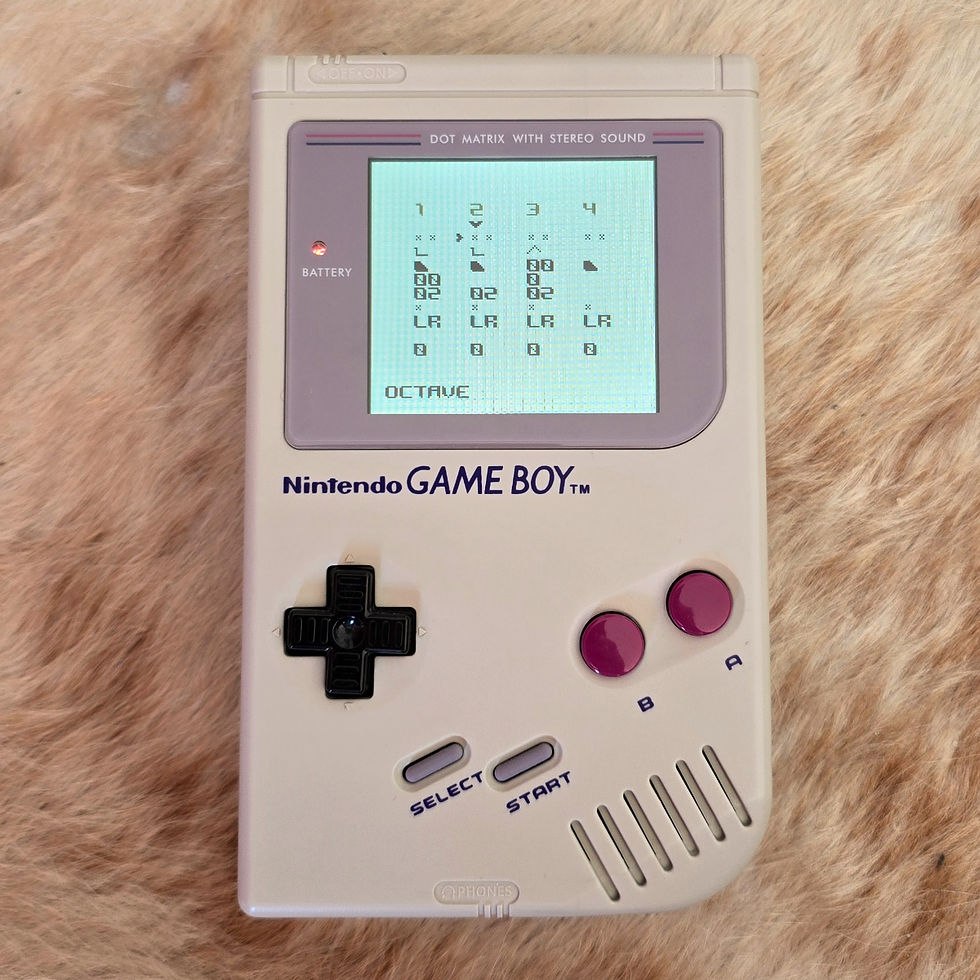
There is even a poly mode that lets you play the Game Boy like a synthesizer, chords and all, rather than one line at a time. It is a strange and lovely thing to hear a machine designed for bleeps and bloops answer a full-sized MIDI controller.
The HobbyChop Pro build
This particular unit is the Pro build from HobbyChop, finished in black, and it is the fullest version of the package. It ships with the five-pin DIN MIDI socket and an mGB cartridge in the box, so it is ready to sync and ready to play as a sound module straight away.

HobbyChop is a maker of chiptune and retro-music hardware, and the Arduinoboy sits in a catalogue that also includes YM2149F and MT32 sound devices, a MIDI-Pi and the Sega-flavoured GenMDM. The firmware on the Arduinoboy is USB-upgradeable and configurable with a small Mac or PC editor, so the unit is not frozen in time. It works across the family too, from the original DMG to the Game Boy Color and the Game Boy Advance and SP.
Why a MIDI box belongs in a Game Boy museum
A collection like this is usually about what a machine was. Devices like the Arduinoboy are about what a machine became. Long after Nintendo moved on, musicians decided the Game Boy's four humble channels had a sound worth keeping, and they built the bridges needed to fold that sound into modern music. That story is the whole reason the museum runs its ongoing series The Sound of the Game Boy, and the Arduinoboy Pro is a natural exhibit for it: proof that a 1989 handheld can still hold its own place in a modern studio.
If the idea of a Game Boy taking orders from a MIDI clock makes you grin, there is a whole wing of the collection waiting. Come wander the rest of the Game Boy Museum and see what else the little grey brick has been talked into doing.


Comments