
The Paper Trail, Part 3: Catalogues and Club Nintendo

Updated: Sep 4
Before an algorithm decided what you would play next, Nintendo mailed the future straight to your door. In the years around the Game Boy's launch, the way you discovered what was coming to that little grey handheld was almost always on paper: a glossy fold-out tucked into a box, a club magazine dropped through the letterbox, a price list pinned behind the shop counter. These modest printed pages turn out to be some of the most honest records we have of how the Game Boy was really sold. Country by country, they show exactly which games Nintendo wanted in your hands, and precisely how it wanted you to feel about them.
The catalogue habit
From the very beginning, Nintendo treated the printed catalogue as a core marketing tool. The trail starts in Japan with the Game Boy Launch Catalogue of 1989, the company's official launch-era booklet presenting the brand-new console, its accessories and its earliest software for the 1989 fiscal year. It appeared just after the Game Boy went on sale in Japan in April 1989, and one small detail gives the game away: it is marked by fiscal year, a sign that Nintendo already planned to publish a fresh catalogue every year. This was not a one-off flyer. It was the opening chapter of a habit.
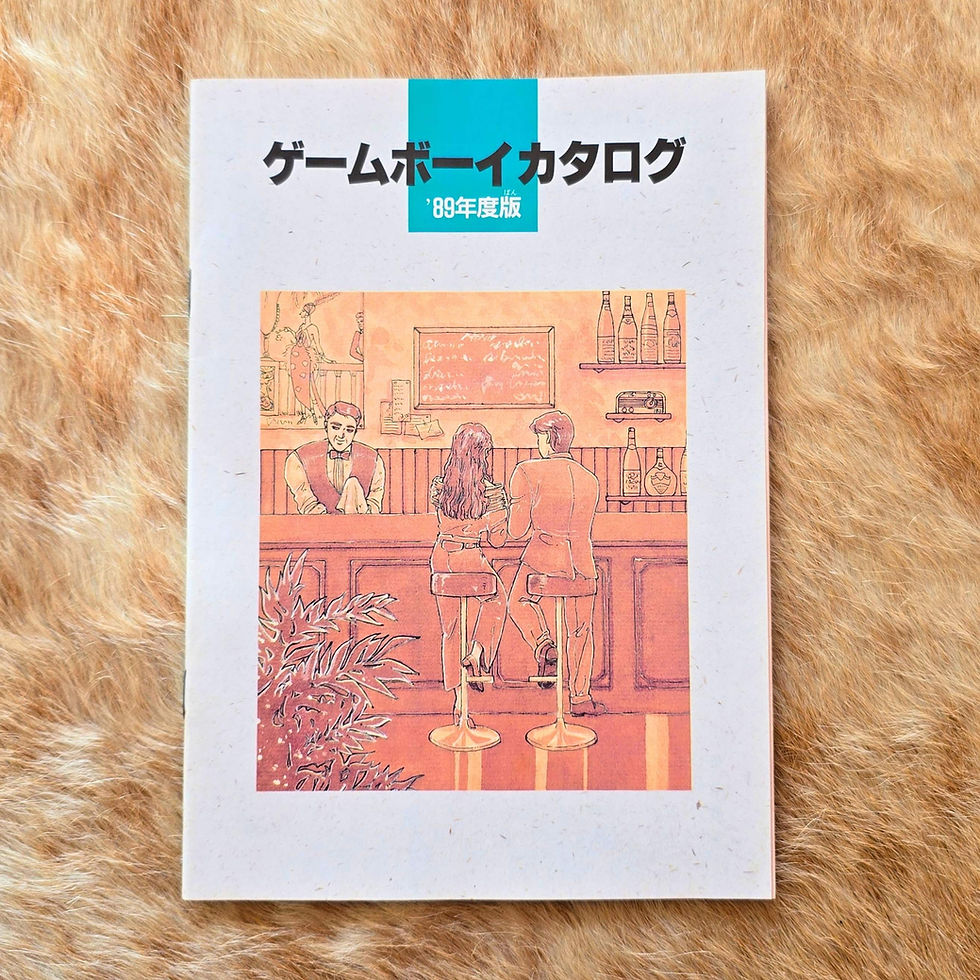
That habit is exactly why these catalogues matter today. Each one is a primary source, a time capsule that captures which titles Nintendo was pushing in a given year and how it chose to present them. Read them in sequence and you can watch the Game Boy library grow, watch the marketing language evolve, and watch the same console being reintroduced again and again to new audiences in new countries.
One console, four languages
As the Game Boy conquered Europe, the catalogue habit travelled with it, and Nintendo simply reprinted its pitch in every local language. Germany got its first dedicated booklet with the Nintendo Game Boy Catalogue 1991, the opening entry in a long run of yearly German catalogues. Britain had the Nintendo Game Catalogue 1992, an official UK edition showing the latest games across Nintendo's systems, followed by the combined Nintendo Game Catalogue 1993-1994 that covered two years in a single volume.
Game Boy Catalogue 1991 Game Boy Catalogue 1992 Game Boy Catalogue 1993-1994
France ran on the same rhythm. The Nintendo Game Catalogue 1991-1992 gathered two years of French releases into one booklet, and the Nintendo Game Catalogue 1994 carried the tradition forward mid-decade. Line these European editions up beside the Japanese original and the strategy is obvious: one console, one carefully controlled message, translated and re-skinned for each market but always steering the reader toward Nintendo's own hardware and first-party stars.
Game Boy Catalogue 1991-1992 Game Boy Catalogue 1994
The German News years
In Germany the catalogue eventually grew a personality of its own. The 1994 edition arrived under the cheerfully loud banner of Nintendo Game Boy Wow! Big News, trading the plain product-list look for something closer to a mini-magazine. From there the German line settled into an almost newspaper-like format: the Nintendo Game Boy News 1995/1996 and the standalone Nintendo Game Boy News 1996 kept members up to date on the latest games and hardware as the handheld matured.
Game Boy Big News - WOW Game Boy Catalogue 1995-1996 Game Boy Catalogue 1996
The run closes on a quietly historic note. The Nintendo Game Boy News 1996/1997 is the last German catalogue to feature original Game Boy (DMG-01) content before the line wound down, making it a kind of full stop on the Game Boy Classic era in print. Held together, these German booklets trace the whole later life of the console, from a breathless 'Wow!' to a graceful farewell.

Nintendo Power, the American megaphone
Catalogues told you what existed. Magazines told you why you should care, and nobody did that louder than Nintendo of America. The Nintendo Power magazine of September/October 1989 used its pages to introduce club members to the newly launched Game Boy, along with its games and accessories. The handheld, designed by Nintendo's Gunpei Yokoi, had reached the United States that July, so this issue effectively captures the American launch moment as it happened. It is one of the earliest publications in the whole collection, and it shows Nintendo Power doing what it did best: turning a product announcement into an event.

For a young reader in 1989, a magazine like this was often the very first place the Game Boy felt real: not a rumour or a shop-window curiosity, but a machine with a name, a designer and a lineup you could already start dreaming about. That is the quiet power of the in-house magazine. It does not just list the games, it makes you a fan of them before you have played a single one.
Club Nintendo and the members' welcome
Europe had its own version of that insider glow, and it was called Club Nintendo. When the Game Boy reached Europe in 1990, Nintendo Germany greeted its members with a Club Nintendo Special Edition, an entire issue built to introduce the console, its games and the available hardware to the club faithful. The Game Boy had launched in Japan in April 1989 and in the US that July before arriving in Europe, so this issue marks the moment the handheld finally landed for German members. It sits at the same point in the story as Nintendo Power's launch issue, only speaking German and aimed at a community that had signed up specifically to hear from Nintendo first.

France got the same treatment in its own accent. The Club Nintendo Magazine 1990/02 devoted a full section to introducing the Game Boy, its games and its accessories to French fans around the European launch, making it the direct counterpart to the German special edition. Between them, these club magazines show the other half of Nintendo's paper strategy: not just selling to shoppers, but rewarding members, building loyalty and making everyone who opened the envelope feel like they were on the inside.

Following the trail
Taken together, this paper trail is a marketing map of the Game Boy's world tour. From a fiscal-year booklet in Tokyo to a Wow! Big News fold-out in Germany, from Nintendo Power in America to Club Nintendo in France, the same little grey machine was introduced over and over, each time tailored to a new audience yet always singing from Nintendo's own songbook. You can browse every one of these catalogues and magazines, page by page, over at the Game Boy Museum. Come and follow the paper trail for yourself.
The Full Series
Part 1: The Game Boy Comic Books · Part 2: Player's Guides and Strategy Books · Part 3: Catalogues and Club Nintendo (you are here) · Part 4: Fan Magazines and Sticker Albums · Part 5: The Books That Made the Game Boy History


Comments