
Pick Up and Play, Part 6: Qix

We finish this first run of Pick Up and Play with the most abstract game of the bunch, and one of the purest quickies the Game Boy ever held. No characters, no plot, no finish line. Just a blank rectangle, a nervous line drifting across it, and a simple, addictive urge to fence off more of the screen than last time.
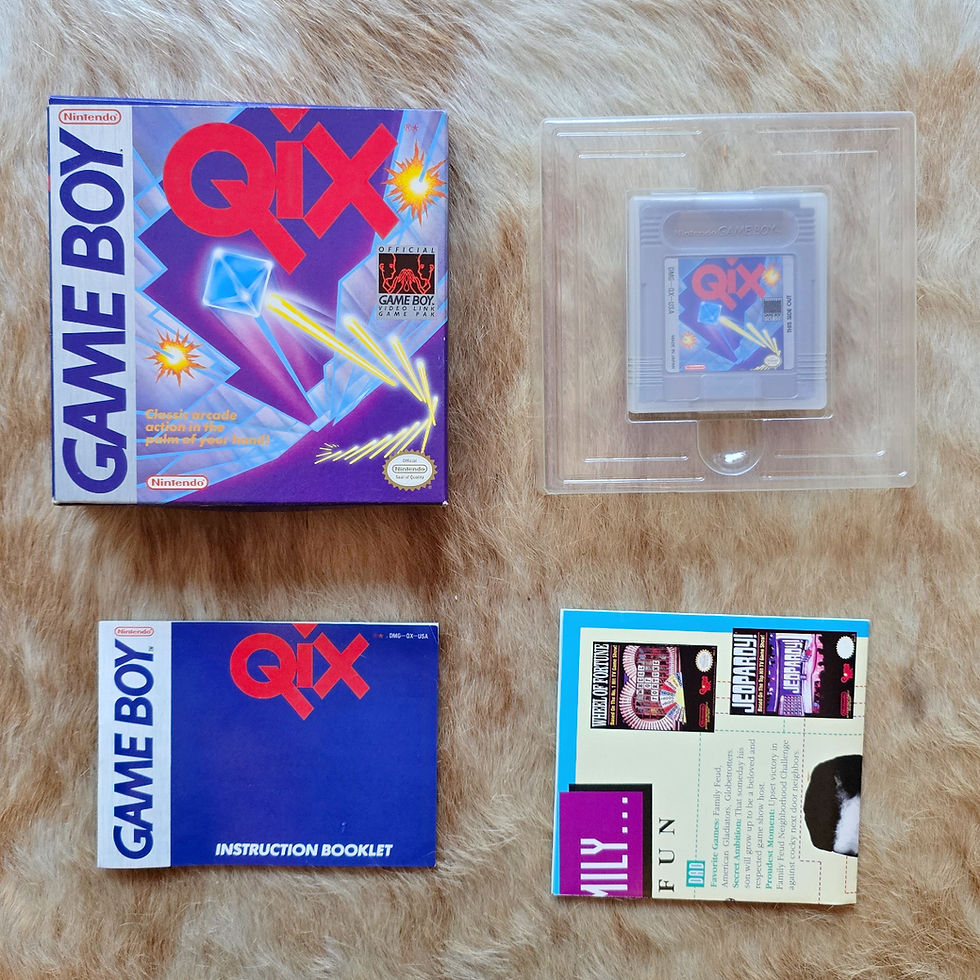
Claim the board, then claim a bit more
In Qix you steer a marker around the edge of a rectangle and draw lines out into the open, fencing off chunks of the board a piece at a time. Claim enough and you clear the level. The catch is the Qix itself, an abstract shape twitching around the middle that ends your run if it touches a line while you are still drawing it. That tension, deciding whether to grab a safe little slice or gamble on a huge sweep, is the whole game, and it resolves in seconds. You can play one nervy round and stop, or chase a bigger and bigger percentage until you forget the time. Either way, nothing is saved and nothing is lost, which is precisely the pick-up-and-play deal.
There is a little more to survive than the Qix alone. Sparks skitter around the edges of the board hunting for the exact spot where you are sitting, so you cannot dawdle on the border either, and if you stop halfway through drawing a line a slow fuse begins creeping up it toward you. Every claim becomes a small gamble with two speeds: draw quickly for a safe, low-value patch, or crawl along for double the points and pray nothing reaches you before you close the shape. Fence off enough of the board, usually around three-quarters of it, and the level is yours.
Like the best entries in this series, it is trivial to start and genuinely hard to master. A first round teaches you the rules by feel, and a hundredth is still tempting you into one risky draw too many. On the small screen its cold, geometric style feels strangely modern, an arcade idea with no fat on it at all.

There is something bracing about a game with no theme at all. Where the rest of this series leans on Mario, Yoshi or a friendly puzzle premise, Qix offers only pure geometry, and on the Game Boy's plain green panel that starkness works in its favour. It looks less like a toy and more like an instrument, a clean test of nerve that could pass for something released yesterday. For a spare minute it asks one honest question, how greedy do you feel, and answers it fast.
That instant resolution is what makes it such a natural quickie. A board is won or lost in well under a minute, and the score screen is a clean full stop rather than a cliffhanger, so you can switch the machine off with no loose ends. Of course you rarely do, because the next board is always right there, quietly promising that this time you will play it more carefully. You will not, and that is the fun.
Qix also turned out to be quietly influential. The simple idea of claiming territory by drawing across a contested space grew into a small genre of its own, from arcade descendants to countless later imitations, and you can still feel its DNA in modern mobile games where the goal is to wall off as much of the screen as you dare. Not bad for a design with no hero, no story and barely any graphics. The idea was strong enough to carry all of it.
Want the deep dive?
Qix has a history far richer than its plain grid lets on: a 1981 arcade original from Taito's American division, a name pronounced kicks, and a Game Boy version that hides a whole wardrobe of Mario cameos, one of which resurfaced in a modern Mario game decades later. Rather than repeat all of that here, we have given it its own feature. If this quick round has you curious, read the full story in our dedicated Qix article, then come straight back for just one more board.
It makes a fitting end to this opening run. We began with Tetris, the game that proved a pocket machine could hold a whole hobby in a few falling blocks, and we finish with Qix, which strips the idea back even further to a line, a box and a steady nerve. Between them sit a doctor, a dinosaur, a bat and ball and a grid of numbers, six different answers to the same quiet question: what can you enjoy, completely, in the time it takes to wait for a kettle?
That wraps our six pick-up-and-play puzzlers and arcade games, though the series carries on with Nintendo's own handheld history. To explore the collection and see these cartridges up close, visit the Game Boy Museum.
The Full Series
Part 1: Tetris · Part 2: Dr. Mario · Part 3: Mario & Yoshi · Part 4: Alleyway · Part 5: Mario's Picross · Part 6: Qix (you are here) · Part 7: Game & Watch Gallery · Part 8: Game & Watch Gallery 2


Comments