
Gotta Collect 'Em All: The Pokemon Corner of the Collection

No single thing did more for the ageing Game Boy than a game about catching creatures. Pokemon arrived late in the console's life, in 1996, at a point when much of the industry had already written the handheld off as yesterday's technology. Instead of fading out, the Game Boy got a spectacular second wind that carried it to a whole new generation of players and kept the original hardware commercially alive for years longer than anyone had expected. In its wake came something collectors adore: an entire sub-world of Pokemon and Pikachu branded hardware, built around the same little grey machine.
This is a tour of that corner of the collection, and it starts, of course, with the games.
The Games That Started It All
The originals came first in Japan in 1996 as a matched pair, designed so that trading between the two versions was the only way to complete the roster. The collection holds both the Pokemon Red and Pokemon Green editions from that original Japanese release, the very versions that started the phenomenon in its home market.
Pokemon Red (JPN) Pokemon Green (JPN) Pokemon Blue (JPN) Pokemon Yellow (JPN)
The West received the equivalent games as Red and Blue, represented here by Pokemon Blue, before the craze reached its peak with Pokemon Yellow, the Special Pikachu Edition tuned to the hit animated series, in which the mascot trailed loyally behind you on screen. Owning the Japanese pair and the Western editions side by side tells the story of how a domestic hit became a global one.

The Link Cable at the Heart of It
It is worth remembering why Pokemon worked at all, because it explains everything that follows. The whole design was built around the humble link cable: you simply could not catch them all on a single cartridge, so trading with a friend was not a bonus feature but the very core of the game. That single decision turned a quiet, solitary handheld into the most social object in the playground, a machine you needed a friend to complete.
It also transformed a technical accessory that most owners had ignored into an essential piece of kit, which is precisely why so much themed hardware followed.
Pikachu Takes Over the Hardware
Success on this scale meant merchandise, and Nintendo dressed its everyday accessories in Pokemon yellow and black. The collection includes a Pikachu-edition link cable, which feels almost poetic given how central trading over the cable was to the games themselves.

Alongside it sit a Pikachu-edition Game Boy Pocket Printer, for printing out your team on little sticker-backed rolls, and even a Pikachu-edition cleaning kit. These themed variants of otherwise ordinary accessories are exactly the kind of pieces that turn a shelf of games into a proper Pokemon sub-collection, and because they were bought to be used, clean boxed examples are far from easy to find.

A Console of Pikachu's Own
Fan devotion produced its own artefacts too, and the collection embraces them. It includes a one-off Pikachu fan-art Game Boy console, a custom, hand-decorated machine that is not an official Nintendo product but earns its place precisely because fan culture is such a large part of the Pokemon story.
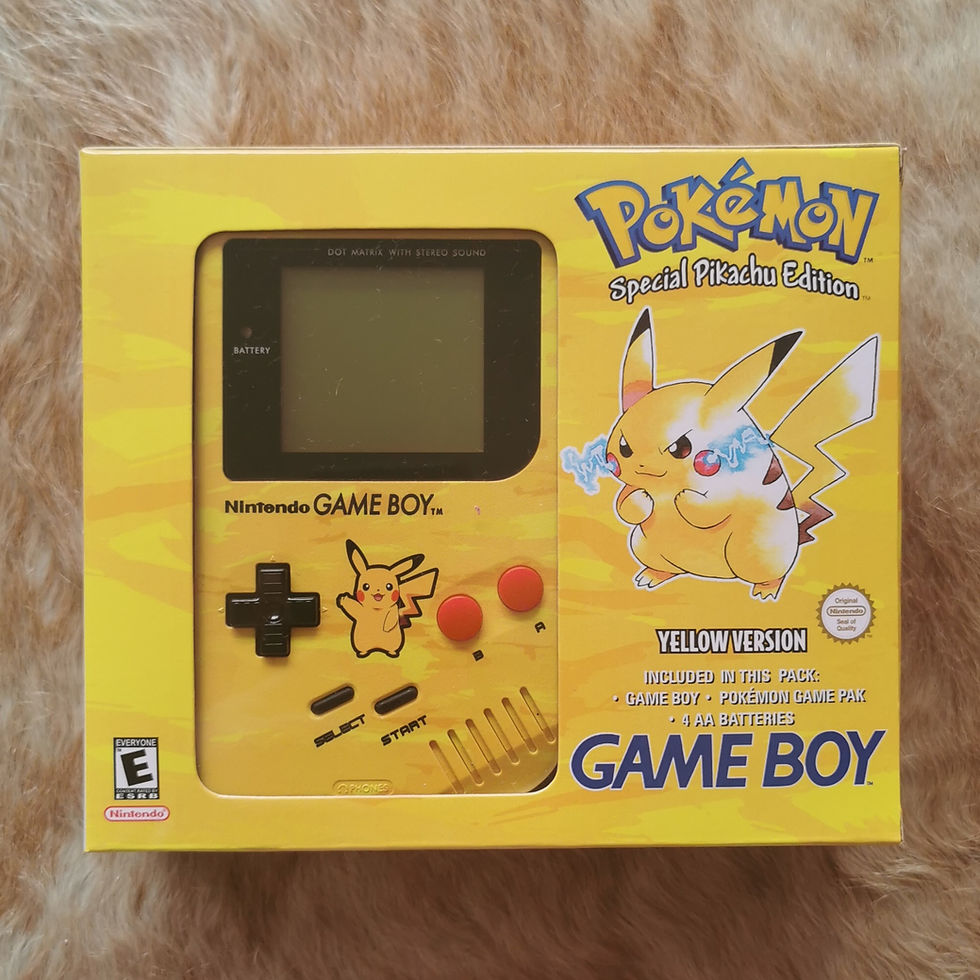
Beside it sits a Pokemon music item, a small sign of how far the brand travelled beyond the cartridge and into every corner of a child's life. Pieces like these capture something the official products cannot: the sheer intensity of affection the games inspired.

Cards and the Wider Craze
The Game Boy also sat at the centre of a much broader collecting frenzy. Period trading cards and Bandai cards show how the console and its characters spilled onto every kind of collectible, feeding the same playground economy of swapping and hoarding that made trading inside the games so addictive.

The line between playing, collecting and trading blurred completely, until owning Pokemon meant owning cartridges, cards, accessories and toys all at once. That total saturation is exactly what a genuine phenomenon looks like.
Why the Pokemon Corner Matters
Gathered together, these pieces do far more than look good on a shelf. They document the exact moment a simple handheld became a global cultural juggernaut, and they show how a single yellow mascot reshaped not just a game library but the accessories, packaging and merchandise around it. There is also a neat historical lesson here: the Game Boy's greatest commercial triumph came not at its launch but near its supposed end, proof that the right software can rewrite a console's whole life story. For a collector, the Pokemon corner is where the Game Boy stops being a piece of hardware and becomes a phenomenon you can hold in your hands.
Explore the Pokemon games and Pikachu-edition pieces, each documented with photos, in the collection.


Comments